Saturday, May 30, 2020

May 2020 Book Bracket

May Book Bracket

May was filled with a variety of books ranging from terrible to excellent to rather odd. Per usual, I ended up with a variety of both secular and religious books on my reading list.

Book Descriptions, Why I Picked Them, and My Impressions


The Blue Fairy Book, Edited by Andrew Lang

This is a collection of 37 classic fairy tales compiled at the end of the 19th century; part of a whole series of color-based fairy tale books, this one includes classics such as Cinderella, Sleeping Beauty, Hansel and Gretel, Aladdin and the Magic Lamp, Little Red Riding Hood, Beauty and the Beast, and Blue Beard. Other titles that might be recognized include Blue Beard, Rumpelstiltskin, "A Voyage to Lilliput" (based on "Gulliver's Travels") and Puss in Boots.

Why I picked it up: This book came from a booth at the Midwest Catholic Family Conference. The reason I acquired it was because multiple books I'd read about C. S. Lewis and Tolkien referenced the fairy tales collected by Andrew Lang as something of precursors to the works of those authors. In my readings, it seemed like the blue book in that collection was the most frequently mentioned of any of the colors (perhaps followed by the green book?).

My impressions: These are about as classic as fairy tales can get. I think the editor altered the stories so that there weren't any fatally shocking elements, but I still found some to be uncomfortable reading. There is a certain quality to fairy tales in which some things are just weird, but some things end up being disturbing. Specifically, there are instances of violence which feel as shocking as they are bizarre. I'm not saying that they don't belong in the story; I just want to caution those who would pick up this book for a family read. I would recommend that, if read, these tales would be best enjoyed as a family read-aloud so that adults could discuss some of the trickier moral points or skip over some of the gorier sections. It was an interesting dive into classic fairy tales, but I did not enjoy most of them nearly as much as my beloved MacDonald tales, "The Princess and the Goblin" and "The Light Princess." There were some pleasant surprises that weren't too unnerving, including The White Cat, Snow-white and Rose-red, and Felicia and the Pot of Pinks. I did skip over Hansel and Gretel (never liked much) and "A Voyage to Lilliput" (disliked Swift's original satire rather strongly).

The One Thing is Three: How the Most Holy Trinity Explains Everything, but Michael E. Gaitley, MIC

This book was written as a sort of "retreat" for lay persons who don't have time to dive deeply into theology. It tackles the "big questions" of life, as well as the "hows" and "whys" of living the Catholic faith, but not in a way that's meant as apologetics.

Why I picked it up: I received this book for free from a day-retreat at my local retreat center. It looked like it was something I "should" read. I also wanted to clear yet another title from my pile of "to-read" books sitting on my shelf.

My impressions: This book was a mixed bag. It has solid theology and I gained some excellent insights from it - one of the main takeaways being that I need to go out and share my faith. However, I can't say this book rocked my world. The author used a more "conversational" tone and lots of summary phrases to help the reader keep the information organized and prevent it from getting to cerebral, I'm guessing. Unfortunately, I found this style a little off-putting and a slight distraction at times as I wondered how many words shorter this book would have been if its content had not been presented in this manner. I skimmed just a few parts here and there and sometimes zoned out, missing the meaning of the words I was reading. I liked the post-conclusion section that included recommended resources to explore, ranging from the Mass and Ignatian spirituality to works of "sacramental imagination" such as the "Chronicles of Narnia" and "The Lord of the Rings" series. I don't know if I'd necessarily recommend this book, but I certainly would not discourage others from reading it. This book took some perseverance to get through, so I wouldn't recommend it for anyone under college-age.

The Giant's Heart, The Golden Key, by George MacDonald

Fairy tales by the same author; one about children caught by a giant and their adventure in escaping him, the other about two children on a quest to find a special land which can only be reached by using the boy's golden key that he had found at the end of a rainbow.

Why I picked them up: A friend, knowing my affinity for other of MacDonald's fairy tales, recommended that I read some more of them.

My impressions: The main thought that came to me is that MacDonald has a weird fixation on grandmotherly figures giving children baths; it happens in most of his fairy tales that I have read, with I think "The Giant's Heart" and "The Princess and Curdie" being the only exceptions (the princess of "The Light Princess" doesn't receive a bath per se, but she spends every second she can in the lake, so I'm counting it). These fairy tales were alright, but they weren't "rave-worthy". "The Giant's Heart" has a moment where the narrator talks about the giant crunching on children like raw turnips that I found a little upsetting, but otherwise was a decent read. "The Golden Key" definitely felt like an allegory and shortchanged the plot in favor of what I guess was symbolism. These stories might be nice for older children to read or to read as a family, but they're not stories that I feel are "must-reads".

The Napoleon of Notting Hill, by G. K. Chesterton

This first novel by prolific writer G. K. Chesterton tells of the literal battles fought for independence by the neighborhoods of London; set in a futuristic London that is actually contemporary London.

Why I picked it up: An author I enjoy reading, Joseph Pearce, gave a talk about distributism that I found interesting and I knew that this book is touted as a defense of that economic system. I also was not quite ready to dive back into easier fiction after pushing through "The One Thing is Three", and this book fit the bill.

My impressions: This is certainly not Chesterton's best novel, but his had the hallmark sense of wonder and the ridiculous that is found in his fiction. I appreciated these childlike elements, but I found this book lacking in terms of being a good story. I also felt like the sense of the ridiculous was not incorporated well into the story as it seems to be in his other novels; rather, the bizarreness of it seemed ludicrously bizarre at times to me and I found myself siding with the antagonists a good part of the time - the main characters certainly seemed like crazy men to me. The book also failed to strike the right notes with me by making little of the blood spilled on account of a neighborhood's identity - there's certainly no just war theory at work here. I can appreciate the wild creativity of wondering, "what would it be like if my suburb wanted to secede and make itself a sovereign state by the use of only antiquated weapons?", but the execution of the scenario did not work for me. The final chapter especially showcased some weakness in storytelling and descended into preaching between two voices that argued different perspectives on the meaning of Notting Hill's endeavors. I could detect the sections that distributists might appeal to, but I felt that message was swallowed up by the philosophical last chapter. I don't think I would really recommend this book unless it were to someone who was very into Chesterton and felt the need to explore one of his earlier works.

Seven Lies About Catholic History: Infamous Myths About the Church's Past and How to Answer Them, by Diane Moczar

Seven sticky subjects that are often brought up by non-Catholics are explained and debunked by a history professor.

Why I picked it up: This was one of the books I acquired from an irresistible $5 TAN book sale. I wanted to know more about these difficult arguments that I encounter now and again.

My impressions: This book helpfully explained both the accusation and the response - it presented the verbage Catholics might hear from non-Catholics and then discusses why these accusations are not really problematic. The author did well to note that, yes, in many of these situations, there were egregious and sometimes immoral errors, but perhaps not to the degree the secular world thinks. However, is it possible that the author's conclusions are influenced by her desire to defend her faith? I think it is possible, but unless I were to take the time and do the work myself of diving into historical texts, I couldn't verify that. I would like someday to have an unbiased look at these topics from a non-Catholic scholar, but until then, I think this is a fine book that does much to inform Catholics and give them talking points when these subjects come up. I recommend this book for high school readers and up, especially for Catholics, but I think this book could be of interest to non-Catholics as well.

Mr. Popper's Penguins, by Richard and Florence Atwater

Mr. Popper is obsessed with all things polar and receives a penguin as a gift from an Antarctic explorer. He and his family (and the growing brood of penguins) achieve fame after training the penguins to perform an act.

Why I picked it up: I obtained about 20 children's chapter books from a retired teacher and I keep them in my speech room. I figured it would be good to know what exactly I have on my shelves, so I periodically pick one up to read.

My impressions: This was not a great read. It was thankfully quick (I read it in the space of an hour or two), but it was very dull. It seemed less like an engaging story and more like a thought experiment on the question of, "What would [x] family do if penguins entered their lives?" It received a Newberry Honor recognition and has been turned into a movie (which I have not seen), which made me even more surprised that it was so dull. There is nothing morally problematic with the book, although Mr. Popper shapes up to be a less-than-admirable father figure, a man who works only half the year and is content to let his family subsist on beans for the other half (at least until the penguins come along). I wouldn't recommend this book, but maybe someone who can't get enough of penguins in their life might appreciate it.

Fever 1793, by Laurie Halse Anderson

Mattie Cook experiences the yellow fever pandemic that overtook Philadelphia in the titular year.

Why I picked it up: This book caught my eye at a bookstore in the last year and I remember having seen it around at school as a tween/young teen without ever having read it. I did not purchase it because I wasn't sure if it was a keeper, but I added it to my "to-read" list.

My impressions: Well, this was an apt book to read during COVID-19 quasi-lockdown, and some of the similarities between this book and reality are striking. COVID's primary symptoms of respiratory issues don't seem quite as disgusting as the vomiting, jaundice, and yellow eyes of yellow fever, but both are/were life-threatening illnesses that involved fevers. The story, which followed the small group of Mattie's family and friends, kept my interest, although I wouldn't say it was a suspenseful page-turner. I enjoyed the coming-of-age element because it depicted Mattie's maturation without feeling like it the author was screaming at me to notice the changes. Mattie's character development is clear, but I did not find it overt - I don't know how it would appear to others. I found that almost the entire book felt real and believable until the end, where an arrangement is reached by certain people who I'm not sure would actually have been able to go into business together in that period. I felt like the author did her research, including quotes from literature produced at that time, particularly letters by Philadelphians. Lots of people die due to the epidemic, including one beloved character, so more sensitive readers might not be ready for this book or the descriptions of the illness it contains. The main character has something of a mini-crush (as one friend would say, a "crinkle") on a young man and I noticed just a part or two where she mentions something like she "shouldn't look at him as if he were a racehorse for sale," although there's nothing racy in the book. I think this book would be appropriate for readers at this reading level and older, unless they are sensitive (or highly concerned about the COVID-19 epidemic).

St. Francis, by G. K. Chesterton

This small book considers St. Francis' life, not in its fact and straight history, but rather in the typical G. K. Chesterton way of considering the bigger ideas and meanings.

Why I picked it up: I purchased this book at some point on Amazon.com. I need to be more careful in future about cheap Amazon books because this was one of the weirdly-reprinted works that was rife with distracting typos. Even the classical painting of St. Francis on the front...depicts the wrong Saint Francis (St. Francis Xavier), not Saint Francis of Assisi.

My impressions: This book was not what I expected. I would definitely say this should be a companion to a biography of St. Francis, not an actual biography. As a standalone work, I found it hard to get into, even though I generally enjoy GKC's writing. My favorite part was a quote: "It is as rational for a theist to believe in miracles as for an atheist to disbelieve in them." These one-liners were one of the first things I loved about Chesterton. I'd recommend this book really only as a supplement to a biography of Saint Francis.

Emily Climbs, by L. M. Montgomery

The second book in the "Emily of New Moon" series follows Emily, a little older, as she boards with a different aunt for high school and continues writing, writing, writing and submitting her works in hopes of seeing them published in magazines. After many everyday occurrences are lived through (and another "second sight" incident), Emily is offered a chance to work with a New York publisher. She turns down the opportunity because she is so rooted in New Moon and wants to be a truly Canadian writer.

Why I picked it up: I remembered that I read the first book in the series last summer and figured it was time to read the second one.

My impressions: I find this series sooo much better than "Anne of Green Gables". I haven't figured out why, but I ate up this book. I think maybe I connect with Emily's experience "clan" of Murray relatives. I know my relatives are far more pleasant than hers, but I hope my family pride and loyalty doesn't blind me to anything. I liked watching Emily mature and found her creative drive fascinating. I wonder if most successful authors share her experience of desperately needing to write, or if there is perhaps some variety (which I hope for, for the sake of my own creative dreams). I'd recommend this book for those who enjoy the "Anne" series, but with a few caveats: I didn't quite like some of the ideas of religion expressed in the book and thought the main "second sight" incident might need some parent explanation - or at least parental awareness - particularly for younger readers. I just don't know what to think of such situations when they come up. Otherwise, I found the book very enjoyable.

Carry On, Mr. Bowditch, by Jean Lee Latham

This Newberry Medal-winning book chronicles the life of American navigator Nathaniel Bowditch. Though he showed great aptitude in mathematics, he had to leave school at an early age and take on an indentured position, during which nine years he educated himself in a variety of subjects, including languages, mathematics, science, and astronomy. He spent some time on ships, developed a better way of calculating longitude, and taught the crew about navigation, eventually writing a more accurate navigation book than anything available at the time.

Why I picked it up: This title was mentioned in "The Enchanted Hour" as a worthy book; the Newberry Medal was encouraging as well.

My impressions: I don't usually like books that lack plot, but I found "Carry On, Mr. Bowditch" interesting and even compelling at parts. Books about sailing have their own special flavor and I enjoyed it very much. I don't know how much of the book is factual and how much "poetic license", but the main points seemed to match up pretty well with the Wikipedia entry for the main character. I'd recommend this book to any reader who can read at this level, but keep a dictionary handy for unfamiliar sailing terms. A good luck charm is discussed once or twice, but comes into the story very minimally. I can see myself reading this again someday.

Bracket Play


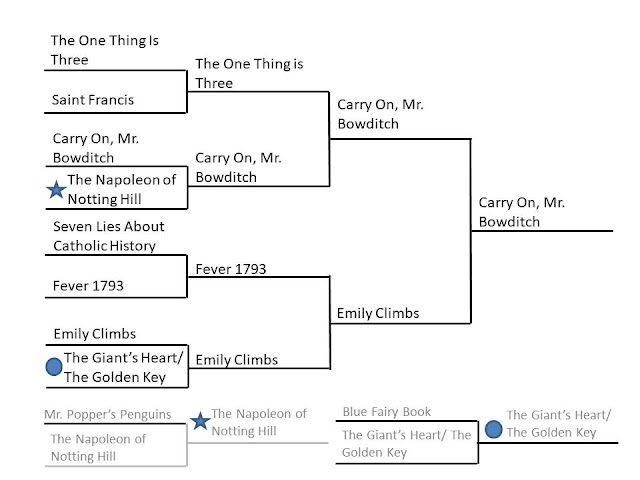
Again, here is May's bracket:

This bracket looks a little different than usual because I had a weird number of books - 10 - that did not fit easily into a bracket. I had two play-in "games" between the four weakest competitors. GKC's "The Napoleon of Notting Hill" breezed past the very dull and lacking "Mr. Popper's Penguins" to make it to the first round, and after a little consideration, the "Blue Fairy Book" fell to MacDonald's fairy tales. The "Blue Fairy Book" failed largely due to the inconsistent qualities of the many tales included - some were weird, some concerning, some classic and familiar, and a few surprising and new. It was too much of a mixed bag when compared with just two of MacDonald's longer fairy tales. Perhaps it wasn't a fair match-up, but bracket can never create a completely even field.

Both play-ins, not surprisingly, failed to make it past the first round, where they were matched with the two books that would eventually become #1 and #2 for this month's book bracket. GKC's "Napoleon" was a bit of a drag and had some weak storytelling, whereas "Mr. Bowditch" managed to work in unfamiliar terminology and bring a bygone age to life without sacrificing pacing or reader interest. "Emily Climbs" possessed a comforting atmosphere that hit in a homey way, whereas "The Golden Key" turned into something of a less-accessible allegory. Two religious books, "The One Thing is Three" and GKC's "St. Francis" went head-to-head and GKC's work again lost out. Both books were somewhat dry and took a bit of perseverance to get through, but I found Father Gaitley's book better organized and focused than "St. Francis," which did failed to explain major points of St. Francis' life or, if it did address some, did so in a nonchronological way that ended being somewhat confusing to this reader, who has not brushed up on her St. Francis knowledge for a while. Finally, it was a toss-up between "Seven Lies About Catholic History" and "Fever 1793". As noted above, both books had flaws, and it was very much a case of comparing apples to oranges. I eventually decided on "Fever 1793" because I enjoyed it more (I lean towards fiction anyways in my personal preferences) and figured it would be palatable to a greater number of readers.

In any case, it did not matter; either book would have lost to "Emily Climbs" in round two. There were no concerns on my part about the historical accuracy of Emily's tales and it was again the charm of the narrative that captured my heart. "Fever 1793" held my interest, but I cannot say that it found a deep appreciation from me like "Emily Climbs" did. Again, a spiritual book did not beat out a work of fiction that I found much easier to get through. I was eager to keep reading "Carry On, Mr. Bowditch" but did not share the same feelings for "The One Thing is Three".

"Carry On, Mr. Bowditch" ultimately won because of its lack of questionable content and its walking pretty well the line between telling an interesting story and showing the characters develop. "Emily Climbs" certainly got down to Emily's thoughts more than "Mr. Bowditch", so she had the benefit of presenting a more nuanced and full character study. However, the fact that I could detect changes in Nathaniel Bowditch without reading excerpts from his written journal every so many chapters shows a different kind of storytelling strength. I can see myself returning to "Carry On, Mr. Bowditch" in future, especially if I had the chance to read it aloud with children. It's a story that both boys and girls can enjoy, which is not something I would think likely of "Emily Climbs".

Books Attempted and Put Down


Catholic Viewpoint on Censorship, by Harold C. Gardiner, S.J.

This book considers the philosophical reasons and theology behind the Catholic position regarding censorship, as well as what the several attitudes towards censorship in the United States were at the time of publication.

Why I picked it up: Believe it or not, I was actually interested in this book when I picked it up on sale at a local Catholic bookstore. Censorship has ties to my perennial questions regarding the role of entertainment in the Christian life - are there books that are inherently bad for all persons? If so, how is that determined? And by whom? - so I wondered what would be revealed in this book.

Why I put it down: This book is "vintage," insofar as censorship looks very different now than it did when this book was published in 1961. At that time, there was an "Index of Forbidden Books." With some Google searching, I found out this was abolished in 1966, although what that means for censorship I don't really know. I experienced a few moments of minor shock as my modern sensitivities recoiled from any prohibition on what persons choose to read or not read - isn't that a violation of free will? I asked. The book answered that question, but I'm not going to work that hard to delineate it here. Even though I didn't make it through the book, I read enough of it to think that I should eventually research more on the ideas I encountered...including such questions relevant to our time regarding license (the freedom to do what is right) and the rights and duties of legitimate authority. Consider, if you will, this timely quote: "Freedom of the press and of expression can, in circumstances, be as legitimately subject to restriction as any other freedom - that of assembly, for instance, in times of catastrophe or plague." If that's not a statement to get all political parties worked up, I don't know what is. Someday I would like to know more on these subjects, but not today...although I anticipate it will be a handy source in the future.

Wildwood, by Colin Meloy, and illustrated by Carson Ellis

This book, created by a husband-and-wife team, follows Prue and Curtis as they explores the forbidden "Impassable Wilderness" of Portland, Oregon in the attempt to retrieve Prue's kidnapped one-year-old brother. Animals talk and have built a society along with humans in the heart of this area, which they refer to as "Wildwood".

Why I picked it up: I saw this book in several places and found it intriguing. The book came up at some point as one that people who liked "The Chronicles of Narnia" might appreciate, so I decided to give it a try.

Why I put it down: After 70 pages, I still wasn't really "into" the book. I decided to look up the plot on Wikipedia and realized that I probably wasn't going to find the next 430 pages much better (yes, it's an unwieldy monster of a book). The writing wasn't bad, but it was what I might call "blah", and the culture of the Wildwood beasts - at least, what I had encountered up to that point - was not well developed. I lacked the sense of wonder and adventure that permeates books like "The Lion, the Witch, and the Wardrobe" and was further disenchanted with the prospect of continuing my read by learning that Black Magic was used to bring someone back to life. Granted, I think that part is recounted as history rather than being described in the book, and the villainess is the one who used it, but any mention of magic raises a red flag for me (even though it's not a death knell). I was disappointed that the book wasn't as good as I had hoped, because the illustrations are amazing and several full-color plates are aesthetically gorgeous. I wouldn't recommend this book both for the content concerns as well as the lack of engagement I experienced while reading it.

Tuesday, April 28, 2020

April 2020 Book Bracket

The physical closure of schools did not give me as much free time as I secretly hoped it would, but I managed to read a good number of books this month - in fact, I averaged two a week. Here's the month's shakedown:


What struck me this month was the excellent quality of the books I made it through. One was definitely sub-par, but all the others had features that recommend themselves for different reasons.

Book Descriptions, Why I Picked Them, and My Impressions


Rebecca of Sunnybrook Farm, by Kate Douglas Wiggin

The American precursor version of "Anne of Green Gables", this book describes the life of Rebecca in Maine as she is brought up by spinster aunts and completes her education. She has many adventures and fits a mold that results in a memorable and endearing tale (please refer to the blog post "Americana Heroine").

Why I picked it up: When I looked under my bed to better rearrange the books I keep there (there are never enough bookshelves), I recalled that I had bought this book from the public library's used book shop area because it was a classic title I recognized. I can't recall the exact reason why I chose this one over the score sitting in my "To-Read" pile on an actual shelf, but it received my attention first.

My Impressions: This book is better than the "Anne of Green Gables" series. I know it's only my opinion, but I liked Rebecca so much better than Anne from the very beginning. Maybe it's because all the excitement is crammed into this one book. Perhaps I always felt like the dreamy, artsy Anne was just a little too much for me (and that's a comment coming from a dreamy, somewhat imaginative person with similar leanings). In any case, this book felt extremely similar to that series, but her scrapes were never quite as uncomfortable as Anne's were for me, which probably made it more enjoyable. I appreciate that the author was content to end the book with the door open to a relationship, rather than solidly establishing Rebecca and her beau as a couple. However, I must comment that there is a significant age gap between the two, which may come across as a little creepy to modern sensibilities. I recommend this book to anyone, especially girls and women who love the Anne series by L. M. Montgomery.

Crusader King, by Susan Peek

This work of historical fiction is based on the real-life King Baldwin IV of Jerusalem. It follows his short career as king and leper from the age of 13 until he died at 24. He battled political maneuvers, and treachery within his own court as well as disease and Muslim armies.

Why I picked it up: This book was part of a Tan $5 book deal and, recalling my rediscovery of Medieval-period historical fiction in the last year, it made sense that I should invest in yet another children's book of that niche.

My impressions: I was not a big fan of the book. The book was a quick read, King Baldwin IV having led an interesting life, but there was no overarching plot and the writing style left something to be desired. Some months ago, a friend pointed out to me that the dialogue in many historical fiction books are written in a way that makes them sound modern. "Crusader King" was such a book, and I admit it was one of the most dissatisfying elements of the book. I cannot say that I would recommend the book. There are no concerns on moral grounds, the book being thoroughly "Catholic" and the author making abundantly clear who were virtuous characters and who were not. However, reading about the ravaging effects of leprosy is unpleasant and could possibly frighten or disturb younger readers. If writing style is not a matter of interest, a more oblivious reader might enjoy this book more than I did.

The Enchanted Hour, by Meghan Cox Gurdon

Gurdon explores the benefits of reading aloud through research and personal anecdotes.

Why I picked it up: This book was recommended by a friend in a literary discussion group to which I belong and my parents gave it to me for Christmas. I had indulged in lots of fiction over the last few months, so I felt it was time to dive into something more non-fiction-y.

My impressions: This is an excellent book. Thanks to classes I took in grad school, I already knew a lot about the link between reading books, language exposure, and language development. However, it was delightful to look at reading from a perspective different from a professional one - I was able to thrill over affirming studies as the bibliophile that I am. This book also made me think. I know that I tend to steer away from books that I think will perturb me and figured that I would be very careful about letting any potential future children read questionable books. As parents are the first educators of their children, I still reserve that right, but this book challenged me to engage difficult texts rather than bowdlerize them or ban them outright, as I am more naturally inclined to do. I didn't agree with quite everything the author had to say, but we were in concurrence on many of her ideas. Reading this book makes me want to dive into my own passion project/pipe dream, that of finding the right relationship with entertainment as a Catholic-Christian. I'd recommend this book for any adult.

The Story of Rolf and the Viking Bow, by Allen French

Historical fiction piece in which an unlucky Icelandic family reclaims its land after many trials.

Why I picked it up: I saw this book at a local favorite bookstore of mine, Eighth Day Books, so I took a picture of it with the intention to read it later. I purchased the ebook version cheaply and decided it would work as a pleasant fictional escape after reading "The Enchanted Hour."

My impressions: The book was enjoyable and had the power to draw me into "another world." However, it was hard to get a sense of what this book really was - historical fiction? Yes, but it also had some mythic elements to it (slaying of ghosts, curses, etc.), which - considering the setting was a country that had only recently encountered and turned to Christianity, it made sense. Some basic Internet research about other books the author has written led me to think that perhaps this was a prose rendering of some Norse epic, but of that I am not sure. Rolf certainly came across as the "epic hero" type in both his personality and in his exploits, but I disagreed with some of the decisions he made at the end of the book. I like "The Red Keep," another book by the same author, better than this one, but "The Story of Rolf" was a pretty fun read that I'd recommend for high school students and older. Middle school and perhaps older elementary could read this book, but some of the vocabulary is archaic and the pagan elements warrant explanation by or discussion with an adult.

Holes, by Louis Sachar

In this children's fiction novel, a wrongly-convicted grade school student must work at Camp Green Lake for 18 months, digging holes as his punishment. He comes to realize that the greedy Warden of the camp is looking for something in those holes, but that is not the only difficulty he must navigate. He and another inmate, repulsed by the corruption and meanness of the adults around them, flee into the wilderness, but decide to come back to foil the plans of those same adults.

Why I picked it up: As an employee working at a temporarily-closed-due-to-Coronavirus-elementary school, I'm spending a lot of time making digital assignments. One way I do that is by working with assignments general education teachers have already assigned - it turns out that some of my students are reading this book. After coming across these assignments multiple times, I developed a hankering to read it again (I read it originally sometime around third grade).

My impressions: This book is a fun read and, even though some characters are mean or even cruel, I appreciated that the author didn't make them extremely dark. It felt like he never forgot that he was writing for children. The main thing I noticed was that there are so many internal connections between characters, locations, and events. I admit that sort of bugged me - at one point, I sarcastically wondered if there would be anyone left at the end of the book who wasn't related to at least one other character. All the same, the author wove together multiple stories well and kept them balanced - with the main storyline having the most time, and the others less. I'd feel fairly comfortable recommending this book to elementary age students, but there are some moments of swearing and dishonesty.


Beauteous Truth, by Joseph Pearce

This book is a collection of 75+ essays by Joseph Pearce, a Catholic scholar who loves all things Catholic Literary Revival (I'm not sure if that's an actual recognized era or just his term for the late 19th-early 20th century period when lots of British authors were converting to Catholicism and writing). He writes on a variety of topics spanning many literary subjects, works, and authors.

Why I picked it up: This was an impulse buy from my favorite small-business local book store. I am very interested in the connections between faith and literature, so when I saw this title paired with the name of an author I had read and listened to before, I knew I had to own it. I hadn't realized that it was a collection of essays - instead of a single academic work - when I picked it up, but it was a great investment (and probably much easier to read than a single rigorous study).

My impressions: Some of these essays gave me great food for thought (e.g., what is the interplay between an author's background, his intended meaning, and the reader's interpretation? Should there be a connection, or is literary criticism all subjective and dependent upon the reader's experience?). I discussed some of these ideas with a gal pal and made note of several of the essays I liked best. However, I found that some of Pearce's ideas are best when taken with a grain of salt (no, I don't think the evidence for Shakespeare being secretly Catholic is overwhelming; it is circumstantial at best, Mr. Pearce). I had to skip through two essays in which he offered interpretations on some pretty dark literary pieces (I am very sensitive and don't need those kinds of story summaries in my life). Fascinating though some of these essays are, I wouldn't call this work a "page-turner". It wasn't exactly dry, but I did feel like I had to push through some of it to get to the next book. To me, reading more academic works is like eating healthy food: it's good for me, but it's not nearly as toothsome as the sugary goodness of fiction. I recommend this book to any Pearce lovers out there, as well as "lifelong learners" and lovers of the writers of the Catholic Literary Revival.

The Light Princess, by George MacDonald

Old-fashioned fairy tale about a princess who lacks gravity - in more ways than one.

Why I picked it up: A fairy tale really hits the spot sometimes.

My impressions: This is my second time reading this book, and it was still just as excellent as the first time. My delight may not have been quite as high as in my first reading, but only because I like to think I've moved from the flightier "first love" to a steadier agape for this work. This is a quick read, but thoroughly enjoyable. It gripped my imagination and made me want to map out a movie or musical version of this story. Unfortunately, there's already a musical that was - ahem - "based on" or "inspired by" the original, but I found the score lacking and the story itself quite different from MacDonald's tale. This story deserves the full animated-movie-musical-turned-into-Broadway-musical treatment, in my humble opinion. I recommend this book to anyone. If possible, find a version with beautiful illustrations. The pictures in my copy are tolerable, but some are a little weirdly proportioned.

The Mystery of Black Hollow Lane, by Julie Nobel

12-year-old Emmy moves into a boarding school and discovers that her long-missing father attended school there years before. She and friends investigate a mysterious and dangerous secret society in the hopes of finding him.

Why I picked it up: This book was recommended on a Facebook group I follow and it was available on Kindle Unlimited.

My impressions: This book had the feel of the "Mysterious Benedict Society" series but held its own as a unique adventure. I greatly enjoyed reading this book and was sad to find out its sequel is not available for free yet. I recommend this book to middle-school age students - or younger, if they are at the reading and maturity level to handle it. Some parts might be creepy for young readers, and the protagonist has a sad, somewhat strained relationship with her self-absorbed mother. There are a few instances where Emmy either lies to or conceals information to deceive her mother. However, there are many kind and noble characters to contrast with those who are self-serving and threatening.

Bracket Play

Here, again, we have bracket play. It was hard to narrow down this time because I'd recommend most of these books for reading with few reservations.

The easiest decision was "The Light Princess" versus "Crusader King." I did not even have to think about it. "Rebecca of Sunnybrook Farm" beat out "Holes" pretty quickly. "Holes" was a fine contender, but had nothing near the charm and delight of "Rebecca". It was a toss-up for both the "The Enchanted Hour"'-"Black Hollow" and "Beauteous Truth"-"Rolf" matchups, but I went with the more academic books because they both lent themselves to deeper thinking and they challenged me, whereas the children's books were just fun.

In Round 2, the children's books turned the tables and beat out Pearce and Clarkson. Inconsistent, perhaps, but even the treasures found in the academic works just couldn't beat out the wonder of incredible fiction. I would bet I'll be rereading the Round 2 winners in their entirety much sooner than the still-excellent losers.

In the final showdown, "The Light Princess" took the top ranking. The tale is short, but powerful in its ability to recharge my imagination and relax my spirit.*

*Interpret results with caution. Bias may be present due to blogger's rose-tinted experience of reading George MacDonald's works for the first time in college when she thought there were no more delightful books left to discover.

Books Attempted and Put Down


This month, I realized that my bracket is not a true reflection of every book I've read; there were several this month that I started but, for various reasons, did not finish. I hope to make this a regular section of my monthly bracket post because I think it will benefit me to record reasons why I did not finish a given book.

White Rose Black Forest, by Eoin Dempsey

This historical fiction novel set in WWII centers on a German woman and the injured Allied parachuter she finds in her vicinity, but it draws in the real-life "White Rose" group that resisted Nazi ideology.

Why I picked it up: This book was recommended to me by a friend and it was in Amazon's Kindle Unlimited selection. I made it about halfway through the book.

Why I put it down: The main character had been on her way to commit suicide and that idea came up several times in the following chapters, which is not a pleasant topic to bring up over and over. She also tells her life story in detail, and the details of growing up and living in Nazi Germany are, unsurprisingly, pretty grim. The book had some of the "page-turner" suspense that makes some books so exciting to read, but it was just too dark for me and I could tell this book really had the potential to mess with my mood. I reached a point where I concluded I could guess the rest of the story in a broad, generalized sort of way, so I had no regrets about not finishing it.

Walk Two Moons, by Sharon Creech

This Newberry Medal-winning book explores relationships and loss from the perspective of a tween-aged girl whose mother died in a bus accident when she was doing some soul-searching.

Why I picked it up: This book was recommended on a Facebook page I follow and have gleaned successful book recommendations from previously. This title was included in Kindle Unlimited as well. Award-winning children's literature has proven ripe ground for new reads in the past (e.g., Sarah Plain and Tall). But now that I think of it, I've had some disappointments from that department, too (Trumpeter of Krakow).

Why I put it down: The writing flowed well and was not overtly artsy, which I appreciated. The beginning started off well, but as I got further into it and more references were made to the main character's mother and the as-yet-unexplained circumstances surrounding why she was not coming back home, I felt a gloomy sense of foreboding growing. I had made it about a third of the way through the book the day I started it, but when it reached a point where I wasn't enjoying it as much due to my forebodings, I decided to look up a synopsis of the book online. I'm glad I did, because it looked like there was going to be a good deal more hardship before there was any healing...and the ending didn't sound particularly happy, either. I was glad to part ways with the book at that point. Maybe some children who have experienced serious loss in their lives would really connect with this book, but it wasn't fun reading for this adult. It was not something I needed to read, so I moved on to the next book in line.

Caught Up In a Story, by Sarah Clarkson

Author Sarah Clarkson outlines the "whys" and "hows" of enriching children with a "storyformed" life.

Why I picked it up: I read "Book Girl" by the same author, in which work she mentioned this title. I liked her thoughts in "Book Girl," and being low-key obsessed with the impact of story on the human person, I added it to my "To-Read" list. I saw my Kindle Unlimited free trial was almost up (sigh), so I squeezed in this one right at the end.

Why I put it down: I wouldn't say I put this one down so much as skimmed through the majority of it. I definitely agreed with the author, but I wasn't learning anything new. This book elaborated her ideas on the subject, certainly, and she draws from her life experiences for evidence, but (ironically) I wanted more data. I think I wanted the same ease of reading with more academic rigor (I'm going to need sources if I ever write a dissertation on this topic), not a subjective case-study approach. I greatly appreciated the ends of the chapters because they contained titles of recommended reads, which I studied fastidiously before returning the book.

Saturday, April 25, 2020

Literary Type: Americana Heroine

I took an American Literature I course in college and found that one of the most interesting things I learned concerned literary "types." I have not done much research into this myself, but based off of the bits I've pieced together from Joseph Campbell's "Hero With a Thousand Faces" (which I've heard talked about but never read...ahem...) and a classmate's final project presentation in American Lit I, it seems that the idea of "types" is applied to stories, in both literary and movie form. I think it's based on Jung's psychology, and the theory proposes that the most popular and lasting stories have characters that fit subconscious archetypes that are shared by all humanity. There are the unlikely hero, the outsider, the guide/guru/wisdom figure, and many more characters, that have a way of showing up in different iterations in all sorts of stories.

I don't subscribe to Jung's ideology and am not convinced of the merits of this form of literary analysis, but I still enjoy picking out character "types" in literature for fun. Therefore, inspired by my recent reading of "Rebecca of Sunnybrook Farm," I would like to introduce a new literary type: Americana Heroine.

(Alright, it's not actually a newly-discovered type; according to Wikipedia, there was a "girl" or "college girls" literary genre that was popular at this time. However, I'm "discovering" it because no one actually talks about it and I'm giving it a better name.)

What is the "Americana Heroine"?

After reading children's literature of this category extensively (i.e., a couple series and stand-alone books by a limited number of authors), I have been able to distill the essential qualities of this character type. My case study samples include the "Anne of Green Gables" and "Emily of New Moon" series by L. M. Montgomery, "Daddy Long Legs" by Jean Webster, "Old Fashioned Girl" by Louisa May Alcott, and "Rebecca of Sunnybrook Farm" by Kate Douglas Wiggin. The shared qualities of these heroines are listed below.

Main Character

The Americana Heroine is always the center of attention in whatever story she is in. It is impossible to keep such a unique personality squirreled away on the sidelines of a narrative.

Adoring Sidekicks

While our heroine must have center stage, it's not much of a story without other people in it. And what beloved literary girl is ever truly happy unless she has less-interesting foils (I mean, friends) to highlight her dazzling personality? Yes, our heroine truly cares for her friends. But these gal pals always seem to hold some level of adoration for their amazing ringleader.

Turn-of-the-Century

The novels in which they star were generally written in the 25 years following the arrival of the 20th century. The one exception in my book list is "Old Fashioned Girl", which was published in 1869. We'll just say Louisa May Alcott was ahead of the trend.

Orphan Child (or something close to that)

The beloved character has many ways of standing out when compared to others, so making her a loner is a great way to accomplish this. By making her an orphan or a child singled out from a poor family to live with distant relations or family friends, there are no siblings to steal her thunder. Her dependency upon the charity of others helps her keep her innocent gratitude for all the blessings in her life, as well as make her an object of sympathy and, therefore, greater affection to the reader.

Struggles With Home Expectations

As an orphaned or destitute child, Americana Heroine's previous experiences have not prepared her for life in a structured (and dull) home environment. Fun shenanigans ensue, as well as awkward scrapes and inevitable reckonings. Disapproving relations play a pivotal role in the discomfort the main character feels; the relation is always won over to some degree by the end of the story.

Solid, Traditional Name

A great way of making the Americana Heroine the kind of "Everygirl" young readers can connect to is to give her the right name. Anne, Emily, Judy (slightly changed from the apparently-hideous "Jerusha"), Rebecca, and Polly are bland, but solid, names of girls everyone would be familiar with and would remember easily.

Some Distinct Physical Feature

This is not necessarily true of all Americana Heroines (I don't remember anything particular about Judy or Polly), but it is a common enough occurrence to warrant mentioning. Authors in this genre are careful to never make their heroines the loveliest in the land, but, seemingly suffering from some guilt over this, make sure to include an endearing feature that somehow makes up for the rest of their lackluster appearance. The feature also probably serves to emphasize the difference between the heroine and the rest of her humdrum society. Who can forget the unnerving eyes of Emily and Rebecca? Certainly not the other characters in the book. And everyone loves Anne's red hair - even she does, eventually. Yes, there must be something so special about our heroine that the difference comes out in her physical make-up.

Imaginative Paragon of Virtue and/or Intelligence

The "imaginative" part is what brings most of the characters round to loving our sweet Americana Heroine. That, or else they must somehow connect to the deeper meanings of life. This character trait sets them up to become a shining example of all that the modern 20th century American girl could aspire to be. Polly instills a love for simple living and familial love in the family of her friends, but also engages in a sort of female-empowerment-through-creative-art community. Anne and Rebecca overcome their wilder tendencies to graduate from prestigious schools and move on to promising careers. Emily's unusual mind captures the attention of different adults who find her a marvel. Judy is picked out from the very beginning as possessing a lively mind with great potential.

Tendencies Towards Authorhood

The potential displayed by the Americana Heroine almost always leads to a desire to write. This was the quality that clued me in to the existence of this literary type. Anne wants to write. Emily wants to write. Others see the germs of genius in the writing of Rebecca and Judy. Polly is a music teacher with no interest in writing, but she rubs elbows with a female authoress in her circle.

Girl Grows Into Woman

A single season would be far too short a time to spend amongst such excellent females. Their stories span multiple years so that readers have time to watch them grow into their best selves (and really invest in the futures of these women).

Falls in Love With Someone Who has Been in Their Post-Adoption/Boarding Life From the Very Beginning

I include this very long and detailed heading because every bit of it is true for every Americana Heroine under consideration here. Our beloved girl grows up and marries a man who has been there the entire time. There's no going off somewhere exotic to find a man; no, it's always some neighbor next door. This set-up is quite satisfying, but in some cases, it can end up being a bit creepy. Don't worry, Polly and Anne, your Mr. Perfect is your age and it seems completely natural that you should fall for each other. However, in the case of the other three, there is at least interest shown by men who are much older than the heroine. Emily, Judy, and Rebecca are all watched over by benevolent and generally well-to-do gentlemen who apparently decide almost immediately that this girl is worth following as she grows up, if not deciding on the spot that they'll marry her once she's old enough. Emily doesn't end up with said fellow in her story, but they come pretty close to it before she ends up with a better-suited peer. Kind of interesting, but definitely creepy, for sure.

Concluding Words

I hope you've enjoyed this literary study as much as I have. I feel that if I keep on like this, I might have a future with Goodreads in their "Recommendations" department.

"If you enjoyed reading this books, you might enjoy the following titles..."

Tuesday, March 31, 2020

March 2020 Bracket

This is the Lent of the coronavirus, also known as COVID-19. I never thought I would live during a time of pandemic, but here we are, and it has meant I've read a lot of books lately. Total book count for the month: 14.

I switched up the bracket mechanics just a little bit, giving all the books an initial standing and pairing them up accordingly. This bracket was developed in Microsoft PowerPoint and I found it much easier to create than previous brackets, which I made in Paint.


Book Descriptions, Why I Picked Them, and My Impressions

Sarah Plain and Tall, by Patricia MacLachlan

A simple and short tale from the Great Plains, this story centers on a family of father and children who invite a woman from Maine into their lives in the hopes that she will stay.

Why I picked it up: I was browsing the Kindle Unlimited selection and this title caught my eye. I had heard of it before, and what with my love of children's literature and the impressive Newberry Medal awarded to it, I needed no other encouragement to try it out.

My impressions: It reminded me strongly of Laura Ingalls Wilder's books, although I think it chronologically falls a little later than those stories.  I imagine this book as taking place at the end of the 19th century. It also is much shorter than the "Little House" books - I read the entire thing in the space of two hours or less. I never knew that a "mail-order bride" scenario could be so endearing, but it was the sweetest thing. There was not much "action" or even much to the plot - widower advertises for a wife, he and his two children begin a letter correspondence, and she visits, and then decides to stay - but this story captured my heart. Not only was the writing beautiful and thoughtful, but it made me yearn for Sarah to stay, just as her potential new family did. I highly recommend this book; it is appropriate for all ages, but those who need some more "Little House on the Prairie"-style books in their lives should definitely check this book out.

Skylark, by Patricia MacLachlan

The second book in the "Sarah Plain and Tall" series considers the difficulties of leaving one home to make a new start somewhere else. Sarah must navigate between memories of Maine and the wonderful people in her new life as a drought strikes the prairie.

Why I picked it up: Who knew there was a whole series? I'd only ever heard of "Sarah Plain and Tall". It was the second book and easily available at the library.

My impressions: Again, a simple, straightforward book, but the tension was heightened this time as the family faces some interpersonal difficulties as well as the problems created by Nature. Even though the characters deal with some very real problems, I felt like I was able to explore and observe them in safety alongside the characters. When I first finished it, I had trouble deciding if I liked this book better or the original. Same recommendation as above, especially if the reader enjoyed the first book.

Caleb's Story, by Patricia MacLachlan

The third book behind "Sarah Plain and Tall" comes from the perspective of Caleb, the brother of the original narrator. Caleb's long-lost grandfather returns to the family farm and the family - especially Caleb's father - struggle to learn how to reintegrate him into their lives.

Why I picked it up: It was the next book in the series I was reading.

My impressions: This book dealt with heavy emotional turmoil. Again, I appreciated how I was able to enter into the conflict without becoming perturbed myself. I am impressed by how real these characters and situations feel, and I maintain the same recommendation for this one.

More Perfect Than the Moon, by Patricia MacLachlan

"Sarah Plain and Tall" series' fourth book is written from the perspective of Sarah's biological daughter. It details her struggle to accept the advent and appearance of a new baby to the family.

Why I picked it up: It was the next book in the series I was reading.

My impressions: This book was not quite as enjoyable as the first three. The narrator really dislikes the prospect of having a new baby brother or sister and is very negative about it. Again, this is a real situation that happens now, too, but the story was not as excellent as the others. All the same, I'd still recommend it, but perhaps not as strongly.

Grandfather's Dance, by Patricia MacLachlan

The final book in the "Sarah Plain and Tall" series has a wedding as an important event, but the focus is on the narrator's relationship with her grandfather.

Why I picked it up: It was the last book in the series I was reading.

My impressions: Thanks to several instances of foreshadowing in the tale, I knew how the book was going to end, and that made it difficult. I won't give any spoilers, but if someone picks up this book, I would not be surprised to find they could guess the ending. Again, this book was not quite as enjoyable as some of the others - likely because of the ending. I also found the narrator's imaginative trains a little on the strange side. For example, she daydreams she is having her wedding. That is pretty normal, I'd imagine, even for a younger girl. However, she imagines her groom-to-be as the family dog. I suppose it's cute, and maybe even that is not unusual, but that certainly rang an odd note for me. I'd recommend this book, but with the warning that some parts might make sensitive readers (like me) emotional.

The World's First Love, by Venerable Fulton Sheen

This book is an admirable and loving work on the Virgin Mary and her role in our lives and in the world.

Why I picked it up: I remember finding this on the discount shelf at a local Catholic bookstore and purchasing it, likely because I had heard of the author before. I tend to work through spiritual books slowly and only one at a time, so it was a while before I actually got around to reading it.

My impressions: This book is excellent. I already had a devotion to Mary, but this book presented some different thought about her and God that I had not considered before. I could tell that Fulton Sheen loved Mary from the way he wrote about her. And he is an excellent writer, too. I imagined that this book was the result of hours and hours of meditation in an adoration chapel. I have no clue if that's accurate or not, but that was my impression of it. I definitely recommend this book as spiritual reading for Catholics, whether you are already familiar with her or not. It can work well as food for thought in adoration, but it's also good just a few paragraphs at a time.

Ember's End, by S. D. Smith

This is the fourth and final book in the "Green Ember" series. In a fight between rabbits and predatory creatures, this is the finale of a good-versus-evil saga. Stakes are high, battles rage, and the evil master of the foes himself comes out to wage war.

Why I picked it up: I pre-ordered this book and was eager to read it because book #3 - "Ember Rises" - ended on quite the cliffhanger.

My impressions: I appreciate what the author did with this series - it was a set of books after my own heart. However, I have to admit that there were multiple elements that I wish were different, especially in this last book. I won't have spoilers here, but for more of my thoughts on this book, please refer to my earlier post about "Green Ember" and "Redwall." I would recommend this book without reserve to slightly older children (10+?) who enjoy anthropomorphic - or even just action - stories, excepting the fact that I do think some of it is too intense for those who aren't emotionally ready for some somewhat dark events.

Paradiso, by Dante Allighieri (John D. Sinclair translation)

This is the third part of Dante's classic epic poem about a man's journey through Hell, Purgatory, and Heaven, this being the final section and the one that focuses on Heaven. Dante is guided by his inspiration, Beatrice, through the different spheres of Heaven.

Why I picked it up: It was time. This poem had been on my list for years, but I had not tackled it until last fall. I had finished "Purgatorio" during my Christmas break, but then I needed a break from Dante. I made good on my plans to read it during spring break, and it is finally read.

My impressions: I'm glad I've read it and now know what some great writers are talking about when they refer to this work. It feels like a big accomplishment. However, I don't anticipate I'll be picking it up again any time soon. I appreciated this particular translation because the translator worked to provide context for obscure references. It turns out that Dante included many of his contemporaries in the work and I had no idea who most of them were - I might have recognized the name of a pope or king or two, but that was it. If I ever go back and read it again, I think I will try a version that has been translated into a poem - this one was rendered into prose. It could not possibly recreate the poem as it was composed in its original Italian, but I wonder how the effect might change if I read it as a rhyming poem. I would not recommend this work unless the reader was an adult who had committed to this big project and could handle some pretty academic topics.

Out of My Mind, by Sharon Draper

This book follows the story of a 10-year-old girl who cannot talk because she has cerebral palsy, and therefore limited control of her body. When she gets an alternative/augmentative communication (AAC) device that helps her communicate, she tries out for and makes it onto the school's equivalent of a "scholar's bowl" team.

Why I picked it up: This had been an option on a list of books to read for my AAC class in grad school, but I passed it over. A social media friend recommended it a while back. And then, Kindle Unlimited happened and it was there.

My impressions: I know that I am positively biased towards the book from the outset because AAC is something that is directly connected to my field of work. I do not work with it to this level myself, but I was grateful that an author had taken the time to write out a story like this. Lots of kids probably see students like the main character and are not aware of the ways their words and actions can unintentionally hurt someone. However, bullying takes place in the story, too. There was a twist that I did not expect and - well, it got me. I think the one thing that wasn't perfect was the taste I had in my mouth at the end. It wasn't the wrong ending, but I think there was something about the tone of the ending chapters that was a little off for me. I would recommend this book for kids (and adults) 10 and older.

Mere Christianity, by C. S. Lewis

This book is a sort of "popular theology" or "layman" look at the Christian faith in God, written by Christian convert C. S. Lewis. It developed from a series of BBC radio talks he gave.

Why I picked it up: This was a reread for me - either the second or third time going through it. Someone mentioned it in the last couple months and I decided it was time to read it again.

My impressions: I was not as wowed this time around as I was originally, but that in no way detracts from the excellence of this book. As a Catholic, there are a few moments when I thought he was off the track a little bit, but most of his theology is spot on. Lewis has a dynamic writing style and uses great hypothetical examples. I would recommend this book to just about anyone high school and older, but for readers on the younger side (specifically, Catholics) I would throw in a word of caution that not quite everything comes off as theologically solid, although it overall is excellent. I would recommend to Christians and non-Christians alike, but for different reasons.

Surprised by Joy, by C. S. Lewis

C. S. Lewis wrote this autobiographical account of how he came to believe in God and become a Christian. He goes through his life from his early childhood, through the death of his mother, a strained relationship with his father, boarding school years, the war, and college. He identifies "joy" as the defining feature of his journey and as the experience of which that ultimately brought him to God.

Why I picked it up: This was another book that long held a place on my "to-read" list, and specifically on the "to-read" area of my shelf. 

My impressions: It is a solid work, but not my favorite of Lewis'. There were some parts - specifically, when he described some of the culture of boarding schools he attended - where again his theology did not seem quite right, but I'm still thinking through that. I learned that he experienced something like scrupulosity at one point, which I had not known before. But his description of "joy," especially as he went through his Wagner/"Northernness" phase, was recognizable to me. The way he described his delight in these things were echoes of some of my own experiences. I am not surprised that that sensation or phenomenon or whatever one calls it was what led him to God. I wouldn't place this book terribly high on the list of "C. S. Lewis books everyone should read," but I am glad to have read it. I read a lot of books about Lewis' works, so it is good to reconnect with the actual works every once in a while. I don't think I'd recommend this book to anyone younger than a pretty mature high school student. Lewis doesn't dwell long on some more mature topics in this work, but they do come up.

I Thirst, by Gina Marinello-Sweeney

Rebecca, a Catholic psychology student, navigates college life and various friendships; first of the "Veritas Chronicles".

Why I picked up this book: A good friend said that she just finished the third book in this series and really liked it, so I decided I'd give the series a shot.

My impressions: This was a pretty light, easy read (finished it in one day); think along the lines of the Regina Doman fairy tale novels or "Catholic Philosopher Chick," if you're familiar with those. I have discovered this genre is not my favorite - I feel bad saying that, but clearly-obvious Catholic high school/college students who must experience modern life and relationships don't hold much captivation for me. Like I said, though, this book has its good points. The friendships Rebecca has are very realistic and her conversations (with her gal pals) sound like those I might have myself. I was a little disappointed about the lack of plot, but it did not bother me much. I was put off a bit more by the style of writing. Rebecca is a poet, and that came across a little too strongly for me in the writing - good chunks of the book are written in what I thought was an overtly poetic manner and it didn't quite work. I skimmed much of those parts and quite a bit of the story she was writing with a friend. This book would probably be enjoyed most by Catholic, college-aged (or slightly past) women.

The Rose and the Sword, by Gina Marinello-Sweeney

Rebecca, a Catholic psychology graduate student, navigates a mentored counseling assignment and various friendships; second of the "Veritas Chronicles."

Why I picked up this book: It was the second book in a series.

My impressions: Pretty much the same as above, with some differences. There was more of a plot this time, but I took issue with the villains. I feel that books in this specific niche all tend to run to the same - situation? - flaw? - perspective? Let me explain. In the Regina Doman fairy tale novels, "Catholic Philosopher Chick" books, and in this book, I have noticed that the antagonists are supposed to be "evil" and it just doesn't come across naturally in this setting. Yes, there is evil in this world, and people sometimes do evil things. But most Catholic high school/college girls who are living their faith are not going to run into the psychotic and/or criminal underworld of society. Most aren't going to come across coworkers or classmates or mentors or future mothers-in-law who are connected to drugs, felonies, or even vandalism. Or if they are, they're usually not rotten to the core. The villains in these books often are. I can appreciate a sincere desire to create tension or action in stories, but I can't help thinking that there is a better way to do it in this genre, even if I'm not sure what it is. This book would carry the same recommendation as "I Thirst."

Consecration to Saint Joseph, by Father Calloway

This book follows the style of consecration in the vein of "33 Days to Morning Glory," etc., but this time it focuses on Saint Joseph.

Why I picked up this book: I had been hearing about this book for half a year when I received it free from my diocese's retreat center, the Spiritual Life Center. Some people on a team with me agreed that we would all do it together and finish it on the solemnity of Saint Joseph.

My impressions: It was a pretty solid book and I'm glad I did the consecration. However, I felt that the author presented some aspects of Joseph's life with a little more "certitude" than was warranted. I might be completely off, but I'll leave it at that. I do feel like I know Saint Joseph more, and I'm always glad to learn more about the saints. I'm curious to see how Saint Joseph works for the Church today, specifically through this consecration. I really loved the artwork Father Calloway commissioned to be made of Saint Joseph - full-color plates are included in the back of the book. I honestly think I might invest in a piece if/when I get married. I recommend this book for any Catholic who would like to get Saint Joseph more; probably high school age and above, but I could imagine this being a great thing to do as a family.

Bracket Play


Here we have the bracket again. As you might guess, it was much easier to eliminate some of the books that I didn't think were quite as good when I pitted the strongest book against the weakest and went from there. This means that the last two "Sarah Plain and Tall" books, as well as the "Veritas Chronicles" books, were quickly eliminated.

However, I was also sad to see "Caleb's Story" fall to "Mere Christianity." The Lewis book won out because it is such a classic and a very approachable apology (Catholic definition) for Christian belief. It was also hard to have "Out of My Mind" win out over the "Consecration to Saint Joseph" book, for more than one reason. Of course, I felt guilty that I would pick a secular children's novel over a book on a spiritual theme, but I went with the former because it was a very solid book and a story that I think needs to be heard more. Of course we should hear about Saint Joseph, too, but...it's hard to compare apples and oranges.

"Sarah Plain and Tall" received a buy on the second round, while another book in the series fell to "Mere Christianity" again. Sheen's book beat "Out of My Mind" because of the author's excellent writing and because of the connection I had with the subject. "Ember's End" took out "Paradiso" because, even though it was not as lofty in theme or execution, it was way more fun to read and it's far likelier that I'll come back to it again. 

However, the flaws of "Ember's End" prevented it from defeating "Sarah, Plain and Tall." And while "Mere Christianity" would win out over "The World's First Love" if I were recommending books to a non-Catholic, this is my bracket, and Sheen's book wins. His love for Mary is so evident in his writing, and the book is both an apology for Catholic doctrine on Mary as well as a way to help the reader love her more.

The final showdown was again difficult, as the contenders were so different. How do you weight the worth of a fictional, non-religious book for children with a nonfiction work about the Virgin Mary? I decided that Sheen's book won, but it felt like a false dichotomy. I would have picked both.

And maybe the next time I read fourteen books in a month, I'll break it up into two brackets - one for fictional works, and one for non-fiction. That might be a better weigh of measuring them.

Thank you for giving this long post a chance. I hope that you have learned a little bit about a book or two you would like to try out sometime.

e

Sunday, March 8, 2020

Redwall and The Green Ember

It's not the end of the month, but I felt the need to write something today. I just finished reading the final book in a series around lunchtime and the urge struck me soon after, but as I'm not mentally prepared to go and edit a large work (which I considered for two seconds), I figured a blog post would do.

The book, called "Ember's End," is the finale of a four-volume tale known as The Green Ember series. The saga details the battle of noble rabbits against their murderous enemies - primarily large birds of prey, but wolves, other rabbits, and other creatures as well.

IF you are considering reading this series ever, STOP reading now, for there will be spoilers.

Consider yourself warned.

Today's conclusion was a big moment for me. I think it's the first time I had to wait for the next book in a series to come out. This marks the first time I ever pre-ordered a book. This is not the first time, but it is one of the bigger times I felt like I had a story that I could potentially spoil for others. And this is one of the only authors with whom I have corresponded on their works. There were many firsts with this series. One of the biggest "firsts" happened with the first book, however. Two years ago, when I first began reading the original, "The Green Ember," I had serious flashbacks to another series I had loved to read while growing up: the Redwall series, by Brian Jacques.

There will not be a bracket for these two series (at least, not at this time), but I would like to compare and contrast them and their respective qualities.

Similarities


It might be best to point out what it is about both sets of books that reminds me one of the other. Both Redwall and The Green Ember series are anthropomorphic accounts of woodland creatures in a "medieval" setting - think swords, catapults, battles, etc. Both series include characters that are noble and vile, and the main conflict generally centers on the battle between good and evil. Herbivorous creatures in these tales are generally on the side of "good," and carnivorous creatures generally fall in the realm of "evil" (a notable exception in the Redwall series being the otters, who are "good" creatures). As one can see, the essential trappings of both series are very similar in a general sense.

However, story structure and other elements line up amazingly well, too. Quests are a big part of these stories, as are the singing of songs and even messages or visions related through dreams. Seer characters and religious orders pop up in both, as do references to ancient heroes of the past. In both sets, stories/the story usually begins with some group of young creatures - innocent and happy - who find themselves plunged into danger and in need of some serious maturation. I would also like to point out that the reader can detect definite improvements in the authors' respective writing styles as one progresses through the series. Illustrations are featured in both sagas.

Even with these similarities, though, I have decided that there are some areas of weakness in both series, and these weaknesses are highlighted because those same areas are often relative strengths for the other work.

What Redwall Does Well


The Redwall series has a lot going for it. It includes 22 books and features a wide variety of creatures in its cast, including mice, hares, badgers, otters, squirrels, shrews, moles, hedgehogs, ferrets, rats, weasels, foxes, wildcats, and others. When I read the books, I felt pretty comfortable with my assumption that Jacques included most of the forest creatures to be found in Great Britain in this series, and therefore figured I had something close to a complete picture of the world. And his world-building was pretty good. As there are many books, and they are all stand-alone stories (but sometimes featuring connections via characters carried over from the previous story in the timeline), a lot of time passes; the maps are different in details, but the main locations stay the same. Redwall is pretty central. A path runs by it on one side, and open space lies on another, with Mossflower wood reaching around other parts of it. Salamandastron is in the south. The sea is to the west. In these essential respects, Jacques stays consistent.

Jacques also works well with multiple story lines. In a typical book, he would have two to three storylines going at once. There is always one for a stationary location - usually Redwall or Salamandastron - which is typically under attack, one for the questing group, and sometimes one for the villain. These lines diverge and remain separate for much of the story, but they converge at some point or another. Jacques switches between storylines easily and did not really spend too much time on one over another. He made use of these breaks to build suspense when appropriate - this is good, but as we'll see later, he does not take it to the level of The Green Ember.

I'll finish up with some of my favorite parts of the Redwall books: food and festivals. Jacques' books are full of delicious food descriptions. I have never tried deeper'n'ever, turnip'n'tater'n'beetroot pie, but I would pay money to have my own slice. Listen to the musicality of that name! Feast descriptions are paragraphs long and give details about everything from the cheeses and main course to the drinks and desserts. Jacques knew how to describe a spread, and he never disappointed me in that regard. Finally,  one of the best parts of the book was the end. At the conclusion of every Redwall novel, there is a celebration. Yes, there is food, but food alone does not a festival make. The party lasts for multiple days, but length of time does not create a proper feast, either. Perhaps the most important element in these feasts is the sense of homecoming. After suffering many trials and surviving manifold dangers, the heroes return home to Redwall and celebrate with their loved ones. The friends who were left behind at the Abbey often have to wait a long time to see their return, and Jacques builds the sense of expectation beautifully. After impatience and longing, all are reunited and healed, and the time to celebrate begins. The festival requires many elements to achieve the right tone: food in abundance, joy and games, good company, sometimes the bittersweet remembrance of fallen friends, and a sense of peace achieved. There is usually some afterword that details how happily things have developed at the Abbey since the threat of evil was destroyed, and then an invitation to the reader to come visit Redwall Abbey again. This final note often breaks the fourth wall, but it feels nice to be considered "welcome" the next time I read a Redwall book.

What Redwall Does Not Do as Well


May I say two words? Formula writing. Brian Jacques found a format that worked for him and he sure stuck to it. I have joked before with my friends that I could probably write a good fan-fiction based off the elements that ALWAYS show up in the stories. I won't list them here, but maybe that could be a project for another day. Much like the plot elements, characters also tended to be flat, both individually and as a species. Yes, some characters developed and gained refinement from their greenhorn beginnings, but Jacques seemed to refer to types more often than not. Hares were always garrulous, gallant, and hungry. Moles always have homely common-sense. Otters are always jovial but great athletes and capable in a fight. I still find many of his books to be unique and enjoyable even if they share the same parameters, but the last four or five books, in my estimation, dropped considerably in their creativity. The books did finally reach a point where they felt like they had "been there, done that."

While I noted that Jacques had been pretty consistent in world-building as far as locations on the map go, I would say that there are some internal inconsistencies that I have noticed. In the first half or two-thirds of the series, he refers to the afterlife as the "Dark Forest." It seemed to me that all creatures, whether good or evil, ended up in this place after death. However, there comes a point when he drops references to the Dark Forest and refers to "Hell" or "Hellgates" for evildoers and...well, there's no reference to any afterlife regarding those who lived well. Another case of inconsistency occurs with the characters of "Mariel of Redwall" and "The Bellmaker." These stories are some of the few that actually happen very close in time to each other, and therefore, there's a lot of carryover in the character department. Unfortunately, if one reads these books one after another, the reader feels that the Mariel and co. of one book are very different from the Mariel and co. of the other. Looking at publication order, Jacques wrote other books in the series between these two, so my guess is that by the time he made it back to the same characters, he'd probably lost a sense of their unique qualities, which resulted in some pretty flat characters in "The Bellmaker." These are the main consistency errors that come to mind for Redwall.


What The Green Ember Does Well


The Green Ember series includes four full-length novels and follows a single storyline. S. D. Smith wrote smaller novellas that supplement the reader's background knowledge of the world of Natalia, but my focus will be on the four main books. As a whole, I think the series' main good quality is that it is an exciting adventure from start to finish. There is nothing formulaic about them, even if you can sometimes tell what direction the story is heading in or what will happen to a certain character. Every location was exciting for me to explore in my imagination. I'm not quite sure how he does it, but reading his books was almost like a feeling of addiction for me - I really did not want to put them down (placing chapter breaks and switching storylines at critical moments probably helps). I needed to know what happened next. Smith, like Jacques, did some great world-building, and his maps are definitely helpful references.

Another area in which The Green Ember excels is in keeping focus in its long-arc storytelling. I sometimes felt like I was being hit over the head with his theme, but the idea that the heroes endure all this suffering for the hope of the "Mended Wood" is well established from the beginning and continues throughout the books. Smith does something that Jacques did not accomplish - and did not even really attempt - he tells one lengthy story. Writing stand-alones is no bad thing, but Smith took on a large project and did well on it.

Character development is an area that, compared with Jacques, Smith does a great job with. Some characters are a little more flat, but the main ones, particularly Picket and Helmer, definitely see a lot of change. And while both Redwall and The Green Ember paint some pretty high stakes, I would say that The Green Ember wins in making the odds feel impossibly daunting and creating a sense of desperation should the heroes fail. In some ways, the dangers faced by Green Ember characters feel more real than those faced by Redwall characters. There is a better feel of the politics involved to get things going of the real disagreement that happens even when people are on the same side. And, in moments when characters might be prone to despair, Smith never fails to present voices of hope that say that things may turn out right in the end.

What the Green Ember Does Not Do as Well


One of the main things I missed from The Green Ember  was the variety of creatures Jacques presented. In Natalia, there seem to be four main creatures: rabbits, birds of prey, wolves, and lizards. That's it. The story was plenty riveting with this limited palette, but I couldn't help but wonder what the story might have looked like if there were other kinds of creatures invested in this war.

Another element I struggled with was how Smith handled storylines. He would spend multiple chapters at a time focused on one group, then cut to a completely different set for a while. This was a good strategy for building suspense, but I think this technique also led to some important moments happening offstage, such as when Heather's father shows up and we discover he has been appointed as the new Tunneler, a vital position that was the result of a fraught decision that the reader does not get to see. To have shown more of the scene would have slowed down the narrative, but I felt like there were several deus ex machina moments that came from this style of writing. 

Granted, at the end of the fourth book, Smith credits Tolkien as his "master," and as a major Tolkien fan myself, I definitely had his idea of eucatastrophe in mind while reading Smith's books. (Eucatastrophe is the occurrence of everything suddenly and completely going right when is seems like it will go wrong; it is the opposite of a catastrophe.) However, there were more instances of this device than I thought were good for the story. At the final battle, there really did need to be a eucatastrophe for anything good to survive (refer above to heightened stakes), but the appearance of a miracle flower that just happens to heal terrible wounds...the fact that some random character who appears out of nowhere just happens to have a bag of its seeds...that was a little much.

Along with these elements, I felt there were some loose ends that Smith did not tie up, specifically in "Ember Falls." Who is the Pilgrim? Emma knew, but I did not at the end. What happens to the things Heather stuffed into her bag in the dragon tomb? What was rabbitkind's best defense against the dragons, to which Lander referred? What were the significance of Heather's dreams? The list goes on. Perhaps these were intentionally left as mysteries. Maybe Smith has some more writing to do about these questions, but for now, it seems like I'm not likely to get any answers quickly.

This last point I will bring up is flavored so much by my experience with Redwall, so I don't know how fair it is for me to mention. However, I will do so, now that I have given warning about my bias. The ending of The Green Ember series was good, but it didn't have the unbridled joy I expected in a Redwall book. Maybe it was because there was not a good description of the food at the feast - for while food does not make a festival, it is a necessary element of it. Maybe it was the fact that I wasn't able to just sit and revel in the moment with the characters - it was on to the next bit of denouement before we'd really taken in the happiness. No one sat and just enjoyed the day - it was a lot of action and doing to the very end. But at least all ended well, and well beyond belief.

And actually, I have one last point: SO. MUCH. CRYING. Weeping is a great way to express deep emotion, but...there was a lot of it.

Conclusion


Redwall and The Green Ember: is one series better than the other? No. They may be better in some respects than the other when the two are compared, but they are excellent adventures about heroic deeds in the eternal battle of light against the darkness. I realize I spent a lot of time picking out flaws in The Green Ember series, but this post has been something of me pouring out my thoughts on the final book, "Ember Ends," which I just finished. None of my friends have read the final book yet, so this is my chance to "talk" about it, in a way. Don't let the number of words written in one section of this review be taken as indicative of the worth of either series. Both are excellent, and if someone enjoyed one, I would definitely recommend the other series to them. It's hard for me to switch gears and turn to other books, but I hope to dive into a Redwall  book soon. Maybe I'll reread The Green Ember series in another year or two. In any case, I think I will write another letter to S. D. Smith and thank him for his work. It's important to let people know when we appreciate something they have done.

Saturday, February 29, 2020

February 2020 Bracket

In January, I decided that I was going to dedicate a lot of my free time this year to reading: reading new books, rereading old books, tackling works that have sat on my reading list for years and I've done nothing about. My total for February is six books, which I consider to be a very good number. I am learning just how many books can be read in a short amount of time, especially if they are short or have a style that is easy to read.

Here are the works I read in February, and how they did on my bracket:

Book Descriptions, Why I Picked Them, and My Impressions


St. John Bosco, by F. A. Forbes

This book is a biography of St. John Bosco, written by Mother Frances Alice Monica Forbes, a member of the Society of the Sacred Heart who wrote multiple books about the saints. The book describes John Bosco's life from birth until death, relating the general events of his life, as well as some miraculous stories and the incredible works he was able to accomplish by God's grace.

Why I picked it up: About a year ago, I saw a Facebook reminder that it was the feast of Saint John Bosco. Remembering some stories my Dad had told me about him while I was growing up, I decided to research him a little. I discovered that he founded the Salesians, an order named after another saint I've come to appreciate, St. Francis de Sales. The Salesian spirituality appeals to me because it has the flavor of St. Therese of Lisieux's "Little Way". Ever since then, I've been asking St. John Bosco for his intercession when I pray the Rosary. So a month ago, when I indulged myself in yet another $5 Tan book sale, I decided that I would purchase a book to learn more about the life of this saint who had caught my attention.

My impressions: This is a pretty straightforward biography with good content, but the writing style is not particularly memorable. I liked getting a view of his life and was inspired not only by his example, but by that of his mother. I was glad to read a saint biography again - it had been a while, and I always find them encouraging. It is a pretty quick read and gives the facts, but I'll probably look for a longer, more detailed book the next time I read about St. John Bosco. I would recommend this book to read and I think a middle-school-aged child would handle it alright.

The Other Side of Beauty, by Leah Darrow

Leah Darrow is a Catholic speaker and author and former "America's Next Top Model" contestant who shares her insights on beauty. She discusses the current beauty industry, its antagonism to human dignity, and calls for women to find their dignity, worth, and beauty in God.

Why I picked it up: I first encountered Leah Darrow's story when she spoke at a conference I attended a few years ago. I know she has a podcast, but it's not on my list of listening priorities. This book was one of the ten that I hope to get through before my Amazon Kindle Unlimited free trial expires.

My impressions: Leah's experiences, insights, and statistics are woven together, with her message of looking to God for fundamental worth taking the main spot. I have to admit that I expected more emphasis on her life or on the data and found myself wishing for more of the "story." It is a good book that would likely have a powerful impact on people who "needed" to hear her message, but I did not feel like it resonated too much with me at this time. I did skim a few parts because I did not feel they were really applicable to my own life, but there were a few pages I skipped because of some experiences she describes from her pre-reversion life. Not a must-read for some, but I would recommend this book comfortably to college-aged and older women (not really men), primarily if they struggle with the world's ideas on beauty. I think a high schooler could read this, but I would be cautious of a few sections.

Further Up and Further In, by Joseph Pearce

Joseph Pearce, a huge Inklings/Chesterton fan and Catholic convert, considers the meaning of the seven books in the Chronicles of Narnia series. He begins with an argument that this series is not just for children, but that adults can appreciate it, too. He looks at the stories one by one, going through them in chronological, not publishing/writing order (stating that the chronological order was the one preferred by the author himself). He discusses the stories and explores their depth.

Why I picked it up: This is another author I've heard speak, this time at an Inklings festival (yes, there's at least one festival that celebrates them!). I've read his autobiography ("Race With the Devil"; he's had a crazy interesting life) as well as some of his other books. This particular title also showed up on a Tan books $5 sale last summer, so I purchased it. I didn't get around to it until now because I felt that I needed a break from reading about my favorite authors and needed to just reread what they actually wrote. I opened it right after concluding my reread of the seven "Chronicles of Narnia" books.

My impressions: I actually disagree with Pearce's decision on reading order because Peter J. Schakel convinced me of his view in "The Way Into Narnia," another book that explores the series in a way similar to Pearce's. However, that's a discussion for another day. I found the first two chapters a bit of a drag because he did not need to convince me that children's literature, or stories in general, can be enjoyed by adults as well as by children. I already subscribe to that belief (and recognized many of the authors and passages he quoted while building his defense). All that aside, I think there is great merit in his analyses of the books. Pearce does incredible research and I enjoyed learning more about these works, especially about details such as Eustace's parents being described as Shavians and the subsequent implications for his character. I would definitely recommend this book to adult Narnia fans (specifically Catholic ones, as the author pulls from Catholic beliefs); young fans could enjoy this book, but perhaps not as much.

The Adventures of Geraldine Woolkins, by Karin Kaufman

This children's book follows episodes from the life of a "new mouse," Geraldine Woolkins, and the other creatures who live in her area. The vignette-style explores different ideas about growing up, courage, taking responsibility, and other lessons.

Why I picked it up: This is another book I can access for a short few weeks on Kindle Unlimited. I had seen it come up in "recommended for you" book lists before and, being a fan of children's literature and anthropomorphic animals, I decided now was the time to give it a try.

My impressions: I like an overarching plotline, so the vignette style didn't quite work for me. The morals were somewhat didactic, but I can understand why the author chose to write in that fashion. I found it interesting that the animals in Geraldine's world refer to and pray to God, and I have decided that I like that detail. Rather than moralizing from some general "natural law" viewpoint, I appreciate that the author decided to refer to God outright and give the book some solid Christian tones. There are some surprisingly intense scenes that involve being chased by hungry predators and/or some other kind of peril to life and limb. One of my biggest complaints is that Kaufman uses the word "hand" instead of "paw," but that's probably an expectation I carry over from my Redwall experiences. I will not be reading the second book any time soon since there are so many more books waiting for me that are higher priority, but I would readily recommend this book to just about anyone; it has good messages and can be understood easily by children, but the intensity of some sections might be frightening.

The Magician's Nephew, by C. S. Lewis

A young boy at the turn of the 20th century becomes entangled in his uncle's magical experiments. His adventure eventually leads to the creation of the world known as "Narnia."

Why I picked it up: I reread the Chronicles of Narnia series in writing order, not chronological order, and this was the next in line after "The Horse and His Boy."

My impressions: It is a good book; while not my favorite in the series, there were some parts I positively loved. Deserted buildings have always held a fascination for me, so the visit to the empty city of Charn was a treat for me to read. The scene in which Jadis tempts Digory to steal a fruit to save his mother is excellent; it boils down arguments any modern person might have for justifying an immoral action (e.g., yes, you made a promise, but you didn't know what you were promising; no one has to know; etc.) and makes them easy to recognize. This more overt style of writing used to really bother me when I was in high school and perhaps even in college, but I don't mind it so much now. There's lots more I could say, but I'll stop myself here for this book. I would highly recommend this book, but after having read at least "The Lion, the Witch, and the Wardrobe"; suitable for children at that reading level.

The Last Battle, by C. S. Lewis

The final book of the series describes the last days of Narnia and the end of that world.

Why I picked it up: It was the next and final book in the series.

My impressions: This book, and specifically the first half, was very hard for me to read. Perhaps I went into it expecting it to be as emotionally wrenching as it was the first (and only other time) I read it. Perhaps I was in a mood. Perhaps it's just hard to read about the abusive, utilitarian "friendship" shared by Puzzle the donkey and Shift the ape. In any case, I almost put the book down permanently about halfway through. Things started to improve, though, and I finished it at last. It is still my least favorite in the series, but I didn't feel my heart being ripped apart. I knew what was coming - (*spoiler alert*) that on the last page it is revealed that the Pevensies and everyone else really are dead, but living now in Paradise - and I think that was helpful. I think I handled it better because, having read the six other books in the weeks prior, I was able to experience that intense longing to return that the children had whenever they left Narnia - and now they would enjoy Narnia forever. I would recommend this book, but with the warning that it can be dark at times and, at least emotionally, hard to read.

Tournament Play

So how did things shake out in the bracket? Let's review:

I tried to pair up books that were similar, and that was a mistake; in sports brackets, the strongest team goes up against the weakest team first, and I did not follow that policy. If I had, "The Last Battle" would have made it past at least the first round. 

In any case, "The Adventures of Geraldine Woolkins" and "The Other Side of Beauty" were easy to rule out. While both good in their own ways, they did not have an overall big effect on me. "The Last Battle" fell to "The Magician's Nephew" simply because I like one more than the other.

In the second round, "The Magician's Nephew" got a pass because it was higher seeded than the other books. "Further Up and Further In" won over the saint biography because Pearce's writing was nicely academic and engaging, while Forbes' book was solid, but a little bland.

In the championship game, "The Magician's Nephew" took the title because it seemed wrong to me that a book written about books should be better than one of the (very good) books it analyzes. "The Magician's Nephew" is a worthy winner because it has not only a good story, but an engaging style, memorable scenes, and themes that are extremely applicable in our own time.