Monday, May 23, 2022

April 2022 Book Bracket

April 2022 Book Bracket

This was a powerhouse month of books. Three, if not all four, of these titles could easily have been the top book for any other month. I really don't want to have to choose a winner.


What Every Catholic Needs to Know about Literature, by Joseph Pearce**

Convert, literature nerd/literary critic, and professor Joseph Pearce briefly touches on (I think?) 100 works of fiction, most of which are considered "literary classics", why Catholics should read them, and what perhaps can be gained from reading them.

Why I picked it up: I wanted to try the free audiobook through the Formed.org app since books are expensive.

My impressions: I listened to this one as an audiobook read by the author himself. Before I say anything else, I want to 100% recommend listening to the audiobook if it is available to you if only because listening to this man speak is about the most relaxing thing in the world. But, going off of that, this is a book that I'd love to have a physical copy of someday. The reason for this is that I want to go back to it and reread it, or at least parts of it. I found myself more determined than ever to read some works which I have failed to pick up ("The Betrothed", for example) and willing to revisit works that confused or troubled me on some level before. One such work includes "The Canterbury Tales" by Chaucer; Pearce gave me perspective on some of what could be going on by including such rascally sinners in a very Catholic work. I appreciated that he said some of these works could be troubling to readers - he didn't pretend that everything was squeaky-clean, and that there can be something to be gained by reading works that include very imperfect, fallen human beings doing terrible things; evil is evil, yes, but if it is being portrayed, that portrayal can serve a purpose (I hope that makes sense). I highly recommend this book to adults, but I'd wish it to be read even more so by high schoolers - I think it would be enormously helpful in forming their encounters with the classics they are required to read at school.

Jesus and the Jewish Roots of the Eucharist, by Brant Pitre*

Biblical scholar Brant Pitre describes what Jewish religious practices and beliefs were at the time of Jesus and what those cultural understandings mean for our understanding of the Eucharist today.

Why I picked it up: I'm not sure when I first heard about this book, but it was highly recommended by one friend and I chose it as my Lenten read.

My impressions: This is a great book - I'd heard some of the information in bits and pieces over the years, but it was nice to have it all together in one place. As with the Pitre work I read last year, I found this book well-researched and easy to read. I regretted reading it as an ebook from the library because the 2-week checkout limit made me feel rushed and I believe that feeling decreased what I soaked in because I was trying to read so much so quickly. However, reading it as a regular ebook without worrying about time limit would likely have been just as good a reading experience as that of other ebooks I've read. I can't say that I was enthralled by it, but I think this is a good book and should definitely be read by those who want to reflect upon Jesus' true presence in the Eucharist.


A Song for Nagasaki, by Paul Glynn**

This biography describes the life of Takashi Nagai, the saintly Japanese radiologist who converted to Catholicism and survived the dropping of the atomic bomb on Nagasaki.

Why I picked it up: This book was highly recommended by a friend and, after my fantastic experience with the Joseph Pearce audiobook, I wanted to take advantage of this one - I started it during a sewing and Easter-egg-stuffing spree.

My impressions: Yes. This book is fantastic. It was beautiful; it touched my heart; it made me cry; it made me yearn for a saintly, God-filled marriage. It is a hard book at times, especially in the section describing the dropping of the atomic bomb and its effect on the victims. I eventually had to skip some of this section because the descriptions were too graphic for me. I think that we of the current time have lost the horror of war - specifically atomic warfare - that grew from the post-World War II era. The books was so well researched and engaging. It gave a view of Japan from what I think would be an authentic Japanese viewpoint, and described ways in which it differed and suffered from American or Western perspectives. Glynn quoted extensively from Nagai's own works and personal journal; this flowed well in audiobook format. I really enjoyed his description of Nagai's grappling with questions of faith and belief because it played like how an internal struggle might actually sound in someone's head. I highly recommend this book to adult readers, but with the warning that there are some graphic descriptions and extremely sad moments, especially in the last third or so of the book.


Forming Intentional Disciples: The Path to Knowing and Following Jesus, by Sherry A. Weddell

Weddell, the founder of the Called & Gifted discernment of spirits program for Catholics, dives into the stats of Catholics who leave the faith and what faithful Catholics can do to evangelize in our culture.

Why I picked it up: This was the book chosen by me and my book-club-of-two partner for this round.

My impressions: Wow, this was a hard book to read at times because I felt called out at times, but it was a book I was so grateful to have read by the end. I felt like there were extremely relevant and practical suggestions for evangelizing those in our parish and also for those who are not in communion with the Church. It was helpful to view evangelization from the perspective of forming intentional disciples - the path of conversion is not just a "believe or don't believe" dichotomy; there are stages that people go through, and the way we approach others should probably be influenced by the stage of conversion we find them in. These stages can happen in any person - Catholics and non-Catholics alike. I think I felt more empowered to evangelize by this book than I have by anything else I can recall having read or listened to. As always, it doesn't mean that I'm suddenly going out and evangelizing more, but it DOES mean I have a resource I can reference and feel more confident about my abilities to share the Gospel. I highly recommend this book for all Catholic adults, as well as for Catholic teenagers.

Bracket Play

It was hard to pick the winner this month since all the books I read in April were very good - and all in their own unique way.


In the first round, the two audiobooks faced each other. I gave the win to Joseph Pearce's book because I think it is an important book for Catholic educators and any Catholic pursuing a liberal arts education to read. However, "Song for Nagasaki" could just as easily have won due to its more objective, biographical nature and potentially wider appeal. It was also an excellent book - so good that it had me feeling things and crying at different times. In the other matchup, the physical book about evangelizing unbelievers and uncatechized believers beat the theological ebook. The reading of the former was a much more relaxed experience than reading the time-limited-checkout of the latter. While I felt I had encountered some of the information included in both works, I felt like "Forming Intentional Disciples" hit me a lot harder and has had me thinking a lot more about the topics it addressed. For this reason, it did win the second matchup against Pearce's book. I'm very likely to revisit both excellent books, but Weddell's work felt more impactful at the time and timely for what is going on in the Church (especially in our Western culture) today.

Tuesday, April 26, 2022

March 2022 Book Bracket

 March Book Bracket Madness

There's nothing particularly sports-themed about my book brackets this month, but the NCAA basketball tournament was one of the inspirations for the format of this blog. I couldn't remember which books I finished when, so I kept just four books for this month to keep the bracket to a good number and pushed the others I couldn't remember well to April's post.


The Books

Heretics, by G. K. Chesterton**

Chesterton takes on many well-known individuals and "types" of his day and explains some of the problems with the perspectives of his subjects.

Why I picked it up: Librivox came through with another audiobook that had been on my list for a while but I hadn't made time to sit down and read. This was one of those books that I thought, "Well, since I read [x book](in this case, Orthodoxy), I should read the 'partner book', so to speak." However, it was pretty low on my list of priorities. Much like the Louisa May Alcott audiobooks, this felt like the perfect format to get this work read.

My impressions: Perhaps audiobook is not the ideal way to encounter Chesterton's more analytical texts. I did not find the book very memorable, and due to the lack of familiar names, I couldn't tell anyone more than one person Chesterton considered in this book. I've found that Chesterton sometimes hits the nail on the head with universal truths or platitudes, but sometimes, he focused so keenly on the issues of his time that I struggle to connect with what he is arguing. The latter case was the experience I had with this book. I think I would have appreciated the work more if I had more background knowledge on the people Chesterton was analyzing. One bright spot in the book was Chesterton's observations on family - although, due to my lack of memory, I couldn't tell you what it was that he said on that topic. This book does not approach the heights of Everlasting Man or Orthodoxy or even Tremendous Trifles. However, in the name of giving the work a fair chance, my experience might have been more positive - and more memorable - if I had read the work. I wouldn't recommend this work to others, especially since there are much better works to sample from this prolific writer.

Elijah in Jerusalem, by Michael D. O'Brien

This sequel to Father Elijah follows the titular character and his brother monk as they travel into Jerusalem to again call the antichrist to repentance.

Why I picked it up: I read Father Elijah a few years ago and I overheard a friend talking about these books recently, which reminded me I needed to try to learn what happened in the rest of the story.

My impressions: This book had a very similar feel to the previous work and they tied together smoothly. It felt shorter than Father Elijah and moved, overall, at a pretty decent pace with a few slightly slower parts here and there. I felt like the author has a strong grasp of spirituality and can develop characters and share their stories beautifully. There was not much plot to this book - much of the story involved hearing the life stories of many of the people whom Elijah meets - but there was enough to lead up to a climax and have me wondering how things would end. I was a bit bummed to find that, after finishing the book, I'm still trying to figure out how things ended. What happened to the main character was pretty clear, but the last few pages raised some important questions that weren't answered. Of course, that recalls Job to my mind, the biblical man who did not have his questions answered at the end in the way he wanted. Amongst a few other important things, I wondered about the ultimate choices of some of the characters and how the rest of the apocalypse played out. There were one or two kind of creepy parts in the book, but they were brief and probably more concerning to someone like me, who is pretty sensitive. O'Brien didn't shy away from sharing from troubling scenes that happened in the lives of a few of the characters, so this is definitely a book for adult/mature readers. I can't say I'd necessarily recommend this book to someone unless they are specifically looking for a sequel to a "religious thriller" (which seems like an extremely niche category to me), but it's a solid sequel to Father Elijah and would likely be appreciated by those who enjoyed that preceding work.

The Little Oratory, by David Clayton and Leila Lawler*

Catholic authors talk about how to set up a prayer space, or oratory, in the home and different ways to make the home a domestic church.

Why I picked it up: This was a free ebook via the formed.org app and has been on my to-read list since I saw it in the shop/bookstore at Clear Creek Monastery. I was on vacation and definitely needed something a bit lighter to read.

Quote: "A husband must be patient with his wife's attention to detail. A wife should never shame her husband with her competence, making him feel inadequate; but with her loving encouragement, he will overcome his doubts and perceived shortcomings. As Pope John Paul II notes, 'in many ways [the man] has to learn his own "fatherhood" from the mother' (Mulieris Dignitatem18). But she must do that as his loving, not scolding, wife."

My impressions: This book is a great companion read to the "Catholic All Year" liturgical living compendium book I read last year. The books cover different information, but it goes together beautifully. This book talked about the basic ideas behind why Catholic families would benefit from having a prayer table at home, decorating beautifully, praying the Divine Office, and participating in different devotions. There were also practical tips and tons of great resources to go along with the information - I was definitely interested in and looked up some of those resources after reading the book. I had a small issue with the book; namely, I felt that there were some claims made that didn't have a lot of supporting evidence. I agree that the home should be beautiful, but I don't know where ideas like 'folk music is especially beneficial to children' comes from (this is not an exact quote and taken out of context, but that's about as much as was said on the topic - there was no follow-up explanation for that claim). There were also a few parts that dragged a bit, so some skimming occurred here and there. I made probably at least twenty notes and highlighted different passages, so from that viewpoint, having the ebook version was great (I'd be very hesitant to make any marks in a book, even if it was my own). I was sad that I couldn't access the pictures at the link they listed (the page doesn't exist anymore), so from that perspective, it would be good to have the physical book. Overall, I'd recommend this to any Catholic adult who wants to think about how they might better incorporate the faith into their home life. I suppose liturgical living pros might basically know what's shared in this book, but I imagine they'd still be able to find something to take away from this book.

The Great Divorce, by C. S. Lewis

Lewis gives a fictional rendering of what the individual choosing Heaven or Hell after death might be like.

Why I picked it up: My boyfriend and I decided this would be a good book to read aloud together, following The Hobbit.

My impressions: This was my third time reading the book and it was again most excellent. I think it would be great to hear as an audiobook, but reading aloud and discussing different parts of it as we went was great. All the individual discussions in the purgatorial space were amazing, and some quite intense. I enjoyed similar parts to previous readings of the book and find them easy to recall - they stick in the memory. My boyfriend said he was invested in knowing how one or two of the stories ended when we paused at chapter endings, and he even had a dream that was uncomfortably similar to some aspects of the book (we made sure to finish it as soon as possible after that). Even though the souls we met were largely nameless, Lewis makes them so lifelike that the reader cares about their choice and can perhaps see such people, or aspects of them, in reality. There are a few topics that might not be totally appreciated by or appropriate for younger readers, but high school readers and above would definitely be encouraged (by me) to read this book.

Bracket Play

I pitted weaker books against the stronger ones, but noticed I had an even mix of fiction and non-fiction. In the non-fiction realm, Chesterton's work lost to "The Little Oratory." Though he had a brilliant mind, the people he considered in his work were too far removed from my experience to be of much interest to me - on the other hand, "The Little Oratory" is a work that I took many notes on and will probably reread, at least in part, some day. In the fiction face-off, O'Brien's work lost easily to "The Great Divorce". I found some elements of "Elijah in Jerusalem" were not satisfactory, at least to my taste. I will probably not reread it, but I enjoyed Lewis' work for a third time reading it. In the second and final round, "The Great Divorce" won over "The Little Oratory". Lewis' work is such a classic, and one of the few that I would say haunts the reader (pun not intended, but we'll claim it if it's there). It's a book that has no boring parts for me and would be more likely to be recommended to others generally; "The Little Oratory" had a couple slow sections and I would recommend the book only to a subset of Catholic adults. 

Sunday, March 6, 2022

February 2022 Book Brackets

 February 2022 Book Brackets

I have to admit, I panicked a little when I came to the start of the month and realized I had some very long or slow-moving books I was working on. I ended up with only three books for the bracket, but perhaps there will be more next month.


My Reviews

The Hobbit, by J. R. R. Tolkien

A hobbit, Bilbo, who is quite content with his quiet life, is sent on an adventure by a wizard in which he will save dwarves, be almost captured by goblins, steal from a dragon, try to avert a war, and find a magical ring before returning home.

Why I picked it up: My boyfriend and I agreed to read this book aloud together soon after we officially started dating. It was at least my third, maybe my fourth time reading it, but his first time.

My impressions: This is a fantastic book for young and old alike. Some people (rightfully) complain that the narrative tone is that of an adult talking down to a child, but it's still a fantastic adventure. The story is engaging, well-told, and the ends are tied up nicely at the conclusion. It's one of the few stories I know that has no hint of a romance and, frankly, has absolutely no need of one. Bilbo has fantastic development throughout the story, and the passing of a character at the end is poignant and touched me, even after having read the book before, recorded the quote, etc. It was definitely a good book for reading aloud. I recommend this book to all readers, young and old, who are at that reading level; it may not be beloved by all, but it has been a favorite of many. Don't watch the Peter Jackson movie adaptation; if you must, read the book first.

Bible in a Year Podcast with Father Mike Schmitz**

Catholic priest Fr. Mike Schmitz reads through and comments on the Bible every day for a year in this podcast.

Why I listened to it: Although it's a podcast, I'm counting this as an audiobook because Fr. Schmitz does, in fact, read the entire Bible. I decided to give this a try because although I'd finally read through the entire Bible, I definitely felt like I should try to engage with it more deeply. I WILL NOT be including this in the bracket because I feel that 1) how could you say the Bible is NOT the best book you'd read? and 2) the podcast was completed primarily in 2021 and just finished right at the beginning of January, so it doesn't even technically fall in this month.

My impressions: One or two of the professors of a class I audited in 2021 implied that trying to read through the Bible in an entire year was a bad idea. No podcasts were named, but I felt this one was implicated in that statement. In brief: I disagree. In detail: I think this podcast is great for the general public, especially Catholics who really haven't taken the time to encounter God in Scripture. I'm sure there are better ways to really engage with the text than the way I did (listening in bursts at 2x speed and taking no notes and always doing something while listening), in which case the professors are correct. However, I loved the commentary Fr. Schmitz gave that didn't shy away from hard topics or confusing passages. Some passages of the Bible were still pretty dry to me, but I would definitely recommend this to Christians and Catholics high school and older (after all, there IS adult content in the Bible).

Hannah Coulter, by Wendell Berry

An aged Hannah Coulter looks back on her life, which spanned much of the 20th century, and gives thanks for it all, from her upbringing in poverty to her first marriage, widowing, motherhood, second marriage, and family life.

Why I picked it up: I had multiple people tell me I had to read this book. I picked it up at my favorite local bookstore a while back (a year or more?), but hesitated to pick it up because one of the people who had recommended it told me to wait until I had time to sit down and savor it. I picked a busy January back at work anyway and read a portion of it during my lunch breaks.

My impressions: Friends, please don't hate this review, but I can't say I was hit super hard by this book. Lovely writing? Yes. Deep insights about life? Yes. Poignant moments that reflected realities that I haven't lived? Yes. But it has no plot outside of the plot that most lives follow: youth, maturation, love, growth, growing old. It is beautiful, for sure, and that hominess and normalness is part of the charm. But it is a book that requires a lot of time to just sit and reflect. It's not a book that I imagine turning to in times of high stress. It's a work that requires a low level of stress and a high level of receptivity already established in the reader for the ideas to sink in. Maybe this review just shows that I wasn't in the right place to read the book (sorry to you, wise recommender, who said to wait till I could savor it). I think this book would be like a drink of cool, refreshing water to the right person in the right time of life. This apparently wasn't it for me. I think it's well written and any adult in the right mindset could enjoy it (but that's true of many books, isn't it?). I'm not quite sure who would like it...I got a"Little House on the Prairie" aura at some points in the book, so maybe people who appreciated those books could find comfort in a story that's very different, but has perhaps something of the same environment as that series. There is some deft wording of intimate things that keeps anything from being sexually explicit - in fact, it's handled pretty tastefully for letting you know what's going on - but I'd say this is a book for adults. I don't think a high schooler would enjoy or appreciate it.

On the Incarnation, by Saint Athanasius

Doctor of the Church St. Athanasius defends the Church's teaching that Christ truly became man, addressing arguments that might be made against this doctrine.

Why I picked it up: I heard from the Word on Fire podcast that this is a seminal work in Christian theological literature, and when I was asked to find one more thing that I wanted for Christmas, I decided this copy (with introduction by C. S. Lewis) from my favorite bookstore fit the bill.

My impressions: This is a text that I think would be good for Catholic high school students to encounter. It is pretty short, but chock-full of apologetical language that powerfully and intelligently defends this elemental doctrine. My one complaint about this edition is that, following the C. S. Lewis preface, there was an introduction that dragged on for 28 pages. The book was only 110 pages long. I felt the information, though I'm sure helpful to the serious student, would have been better appreciated as an afterward, or study guide, of sorts. Frontloading all the analysis at the front end of the book was NOT fun. I didn't feel like I had any major spiritual moments from reading the book, but it is so good to be able to say that I've read this work and to know that I can reread it.


Bracket Play

As mentioned above, I did not include the Bible in bracket play because it would win by default.

We have two works of fiction facing off in round one; one a fantasy written for children, one a piece of modern fiction for adults. The children's book won, of course (there are exceptions to this tendency, but at the very least, I'm not surprised by this). While I think "The Hobbit" is more memorable and more accessible, the theological classic won because it's such a classic and treats on such a fundamental doctrine of Catholicism.

Wednesday, February 2, 2022

Book Brackets January 2022

 January 2021 Book Brackets


Some audiobooks and children's fairy tales helped bump up the number of books read this month, but there was also time for some Catholic works, too.

Book Reviews

The Twenty-four Days Before Christmas, by Madeleine l'Engle

Middle child Vicky experiences the joys and anxieties of the Advent season as she prepares to be the angel for the church pageant and wonders if her mother will have the baby in time to be home for Christmas.

Why I picked it up: The author of the "Catholic All Year" compendium mentioned this as a recommended read during the Advent season. It was available in my local library system.

My impressions: This very short book (less than 50 pages) is a realistic-feeling story about one family as it prepares for Christmas with different special activities during every day of Advent. I liked the religious references, the focus on family, and the overall homey tone of the book. There were some very beautiful comments in the book, such as the only thing we can truly give God is ourselves. It's not something I anticipate reading again, but I think it could be a nice read for a child during Advent.

The Princess and the Goblin, by George MacDonald

With the help of her great-great-grandmother, Princess Irene and the miner boy Curdie work to foil the plan of the goblins who live in the mountain.

Why I picked it up: I wanted a comfort read and figured this would be a good one since I hadn't read it for a while.

My impressions: Not as magical this time as the first read, but still a great story. I like being able to sense theological underpinnings to the story. However, some weird parts are still weird (great-great-grandmother has Irene go to bed with her; gives her a bath even though Irene is eight years old...not sure what was needed there), and the descriptions of the goblins, their creatures, and some of their conversations are still kind of creepy to me, even as an adult and reading this book for at least the third time. It's a good fairy tale with some very likeable characters; however, it might not be suitable for young readers of fairy tales if they are sensitive to scary things...or if parts of it are just too weird.

Little Men, by Louisa May Alcott**

Jo and her husband, Mr. Baehr, have a school for many young boys and a few girls, and guide the growth of their charges to become virtuous and the best versions of themselves.

Why I picked it up: I wanted another audiobook (**) and this book was available as well as on my list of books to read. It was narrated by four or five different volunteers.

My impressions: Having different narrators was not as enjoyable an experience as having the single reader for "The Thirty-Nine Steps", as some were easier to listen to than others, but it did not interfere with the experience too much. As for the story, there's not really a plot, but lots of character development. It's one of those books that just follows characters around as they grow up. The stories are interesting enough to keep attention, but it's not a page-turner, by any means. An audiobook was probably the best possible way for me to "read" it since it was easy to have it going while I worked on other things. Those who enjoyed "Little Women" would probably find something to like in this book, but I don't foresee myself picking it up again for a reread.

The Princess and Curdie, by George MacDonald

Princess Irene's grandmother sends the miner boy Curdie, along with some grotesque but good creatures, to save the king from disloyal, plotting subjects.

Why I picked it up: I had finished rereading "The Princess and the Goblin" and it seemed proper to follow it up with the sequel.

My impressions: This is going to be a longer review because there's a decent bit of thought generated by reading this book and the original tale by MacDonald; I guess this is more of a book report and comparison-contrast. So, skip the next part if you want to avoid some spoilers. I'd say this is a darker book than the original, and not quite as good. The "bad guys" in this story were humans, and many of them basically were jerks if they weren't downright conniving. There was also a lack of the lightheartedness that came up at times in the original (for example, no stomping on goblin feet in this book - just lots of mean people). It is the more violent of the two books as well, I'd say. Curdie kills several creatures, there is a battle at the end, and the fifty terrifying goblin creatures wreak havoc on unrepentant scoundrels in a manner that the animal rampage in C. S. Lewis' "That Hideous Strength" evokes to bloodier effect. However, it was still an interesting read - I found myself wanting to have more time to read it, even if it didn't have a thrilling "page-turning" quality. This book had one main storyline to follow, whereas the original wove together two different narratives very harmoniously. I appreciated that we got to follow Curdie and that he was not a static character. I don't know why the goblin creatures reappeared in this book, but giving them more time and showing that they weren't necessarily evil, although they were ugly, played well with other great fairytale elements, such as a special ability Curdie is given by the grandmother and the fact that the virtuous and the vicious do receive their just desserts in the end. I felt like MacDonald tried to slip more social commentary into the narrative, and it wasn't necessary, but it also didn't take up too much time. I recalled from last time that the very end of the story is a sort of epilogue that is quite sad (at least to me), so I tried to stop before I read all that again. I was disappointed that a key goblin creature, Lina, was hinted to have been a woman at some point and took on an ugly form after doing something bad, but that was never actually resolved. I found that rather unsatisfying. Overall, this book is probably less suited to young readers than the original is, and it should definitely be read after the original. Last notes: the townspeople talk about exorcising the palace, where they have mistaken goblin creatures for demons, so parents sensitive to that sort of thing might want to be aware. Also, a religion is mentioned and the head minister depicted in a not-so-flattering light, in the way of commentary on real life, I believe - just so you know.

The 21 Undeniable Secrets of Marriage, by Dr. Allen Hunt

Catholic convert Dr. Hunt lays out the twenty-one titular secrets of marriage in a quick, easy-to-read book that includes an explanation of each secret and a practical way to practice each.

Why I picked it up: My mom had started reading it and passed it on to me so that I could get a better idea of what is called for in a marriage.

My impressions: I think this book would be great for Catholic couples to read. It is definitely directed towards couples who are already married, but I believe I gained some good insights from this book. Some of it was already familiar to me (the love languages, not going to people outside the marriage to resolve all problems, etc.), but some was new. I don't think I'll remember much right now because I'm not actually married, but I think it would be a good book to keep around to reference if and when I get married. I liked the stories of couples that were included in the book - narratives always have so much to attract! I'd definitely recommend this book to married Catholics, whether they are new to the sacrament or have been married for a while (wow, that probably sounds really presumptuous coming from an unmarried woman!).

The Reed of God, by Caryll Houselander

In a work published in the midst of World War II, Houselander reflects on Mary and her qualities, and through Mary, on Jesus Christ.

Why I picked it up: I wanted to read this book for Advent because it had been recommended as a good Advent or Lenten read. I didn't finish it until well after Christmas Day, however.

Quote: "Each saint has his special work: one person's work. But Our Lady had to include in her vocation, in her life's work, the essential thing that was to be hidden in every other vocation, in every life. She is not only human; she is humanity. The one thing that she did and does is the one thing that we all have to do, namely, to bear Christ into the world." - pg. 4

My impressions: This is an excellent book and I want to reread it again in a few years. The book is about Mary, but by the end, I found the focus was more exclusively on Jesus. I appreciated this and the fact that the focus switched so naturally, because it is a way to show how growing close to Mary is really growing close to Christ. Parts of it were hard to read, like feeling called out about "flinching" over hard passages in the Gospels, but so much of it was beautiful. It was again hard to pick out one quote because many spoke to me or were so lovely - "the indefinable lightness of heart which descends upon him like Pentecost" (- pg. 106) jumped out at me as I reread the quotes in my florilegium for this book. I was able to start practical application of one idea right away - a simple thing, greeting Jesus silently in each person I meet (if I remember), but there were many points that would have worked well for meditation. I highly recommend this book to any Catholic who is up to that reading level; it is definitely what I would call a spiritual classic.

Jo's Boys, by Louisa May Alcott**

The boys and girls of Plumfield come of age around the world or at the nearby higher education institution, some making their way, some falling in love, some having adventures, but all growing in maturity and virtue.

Why I picked it up: I wanted to "read" (listen to) the last book in the series of Little Women and Librivox was a good way to do it.

My impressions: This book would have been easier to read through in book form than Little Men: I feel that, while there was still not much plot, the episodes were more interesting and "higher stakes" than the woes and joys of the youngsters. It was fun to see how the characters had developed and continued to through the course of the book. I detected some strong "drawn from real life" sentiments about being an author expressed through Jo, but I don't know how much was for the sake of story and how much was perhaps just Alcott venting. It was a good finish to the series, with the lives of the children being summarized nicely in the last paragraph. However, I got the sense from that last chapter that Alcott was ready to be done with this fictional family and was trying to head off any questions by wrapping things up so nicely. I'd recommend this book over Little Men, but it's not a "must read". It should not be read without reading Little Men first, however.

Bracket Play


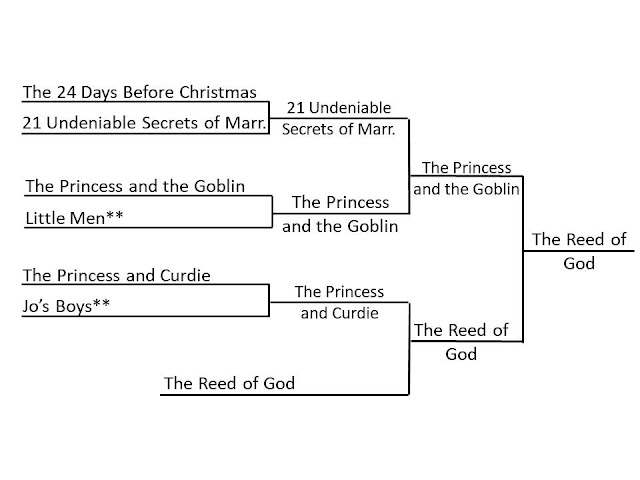
I read an uneven seven books this month, but bracket play still worked out nicely; I gave "The Reed of God" a buy for the first round since it was so good. The book on marriage easily defeated the minimalist "24 Days Before Christmas", and a favorite, "The Princess and the Goblin" likewise beat the plot-weak "Little Men". However, the match was closer between "The Princess and Curdie" and "Jo's Boys". I ended up handing the victory to "The Princess and Curdie" because I figured I'd be more likely to reread that one myself. However, that hard-fought victory came to naught, because "The Reed of God" trounced it in the next face-off. The game was very close and I couldn't really decide...I was going to announce "21 Undeniable Secrets" as the winner, but I felt like I was betraying a beloved book that had meant so much to me...so I had MacDonald's book win. In any case, I figured it didn't matter too much, because I knew "The Reed of God" would win it all this month. No prizes for second place, but I do want to make a not that I couldn't really decide between those two books. "The Reed of God" was sometimes hard to read, particularly sections that I felt called me out, but I was encouraged and felt like I learned a lot and could apply some of the concepts in my own life right away.

Sunday, January 9, 2022

Book Stats for 2021

The end of the year snuck up on me after a very slow two weeks of COVID at the beginning of December. I haven't even finished my December post and yet, I am here, starting work on the number crunching for the entire year.

Totals

Total number of books read each month (a few months have a parenthetical number because they were rereads of "Searching for and Maintaining Peace"):
January - 8
February -  7
March - 4
April - 5
May - 6
June - 6
July - 6
August - 3
September - 1 (2)
October - 2
November - 3
December - 6 (7)


Compare with the totals for (2020)
8 - January - (7)
7 - February -  (6)
4 - March - (14)
5 - April - (8)
6 - May - (10)
6 - June - (14)
6 - July - (8)
3 - August - (7)
1 - September - (5)
2 - October - (5)
3 - November - (5)
7 - December - (8)

Number of books read over the entire year of 2021: 57 (40 fewer books than 2020)

Total number of books attempted, but put down: 5

Percentage of books started and completed: 91% (same as last year)

Books being read, but not completed, at the end of 2021: 4

Percentage of completed books read on my Kindle: 21% (12 books total)

Percentage of completed books read via audiobook: 2% (1 book total)

Percentage of books that were rereads: 12% (7 books total)

My Reflections


I knew that I wasn't going to read as many books this year as I had last year, but I didn't realize I would be FORTY books short of last year's number. That kind of hurts. However, my social life picked up this year and I ended up starting a relationship with a fella, which seems to take some time that was previously given to reading - well worth it. I am please I made it past the 50 book mark.

There was a slight increase of 4% in books read by Kindle; I "read" one book via audiobook this year (2%) and I would not be surprised at that percentage either increasing or staying the same in the coming year.

"It looks like for every 10 books I started, I put down about one for various reasons. Some were discarded because of lack of interest; others because I didn't like the way they affected my thoughts." This sentence is copied from the post last year, and is still true. However, I noticed that I may not have made note of every single book I put down and/or I put books on hold temporarily that may be on hold for a while yet, meaning that they are in a kind of limbo - they are not permanently put down, but I honestly don't know when I'll finish reading them.  

Slightly over one out of every five books was an ebook; this percentage increased from the last year. The availability of public domain works in free ebook form has had an effect on the medium through which I access some books. I still prefer the physical copy, but I can't deny that ebook options from the library or the public domain are quite attractive.

Genre Data

I broke up the books I read into the following genres: Spiritual Works, Fiction, [Auto]Biography, Philosophy/Literary Criticism, and Non-Fiction. I removed the "Other" category I had from last year and gave non-fiction its own count this time around. Some subdivisions exist within the larger genres of Spiritual Works and Fiction. Some of the works didn't fit neatly into one group, including several in the "Non-Fiction" section; however, this first graph has NO overlap: each book goes into one genre, no more.


And to compare with last year, I actually read a lower percentage of fiction this year (53% this year, 60% last year), which surprised me - I thought from looking at the lists in my Excel spreadsheet that the percentage would have been higher. The spiritual works percentage dropped two points, which I'm not crazy about, but it's really right about where I was last year. It does make me want to be conscientious about making sure I'm getting spiritual works read throughout the year, though. [Auto]Biography was about the same, as was Philosophy/Literary Criticism, but wow - Non-Fiction jumped from being part of the Philosophy/Lit Crit group to having its own designation. Perhaps it just helped fill the gap left by "Other". Overall, it doesn't seem like my reading habits changed too much last year. It looks like I need heaping doses of fiction, though!


It looks like last year, I broke down the two genres from which I read the most books - Spiritual Works and Fiction. I figured it wouldn't hurt to do something similar this year. 

For Spiritual Works, I actually included some books that ended up in different genres in the first graph (Non-Fiction, [Auto]Biography) because they were hard to categorize. I changed two of the three categories as well (last year's were Theology, Apologetics, and Lives of the Saints; I only kept Apologetics). There were 15 books considered for this graph.


It looks like my comparative percentage of apologetical works increased, so I met an informal goal set last year (read: "I think that it would probably be good for me to increase my intake of apologetical works since I'm pretty timid about sharing my faith." - me, Book Stats for 2020). I hope I read at least as many spiritual works next year (there's another informal goal).


I did not overlap my books this year (i.e., each book was placed in only one category), so the stats for fiction look quite a bit different than last year's. The splits looked fairly equal to each other. I think my classics consumption increased thanks to the class I audited during the spring semester. Even though I did not distinguish between adult and children's fiction, I still read an exorbitant number of books targeted to child or young adult audiences - 18 of the 30 books, so over half of the fiction books read. 

My Reflections

I was disappointed by the lower number of books read, but a little perspective change helps - after all, I still read nearly 60 books! I think that, overall, the books last year were more memorable or better quality than this year. Even with the classics, I think more 2021 fiction books were fluff reads than the fiction works read in 2020. However, that is not to say that I didn't read some fantastic books. I read about the same number of rereads, read more ebooks (comparatively), and decided that audiobooks can be pretty nice (as long as you don't forget you have granola cooking in the oven and can't hear the timer go off because you have your headphones on...hypothetical situation, of course...).

Best in Genre

Like last year, I wanted to pick the "Best in Genre".

Spiritual Work: Searching for and Maintaining Peace, by Fr. Jacques Philippe
Fiction (Classics): The Song at the Scaffold, by Gertrud von le Fort
Fiction (Historical): The Lost Baron, by Allen French
Fiction (Fantasy): The Ordinary Princess, by M. M. Kaye
Fiction (Other): Till We Have Faces, by C. S. Lewis
[Auto]Biography: The Life of Christ, by Archbishop Fulton Sheen
Philosophy/Literary Criticism: Seeds of the Word, by Bishop Robert Barron
Non-Fiction: Apologetics and the Christian Imagination
Reread (besides "Searching for and Maintaining Peace): The Ordinary Princess, by M. M. Kaye

Fiction (Other) was a tough one to call - also under consideration was the reread "The Awakening of Miss Prim", but I thought that Lewis' work had more food for thought.

Monthly Winners

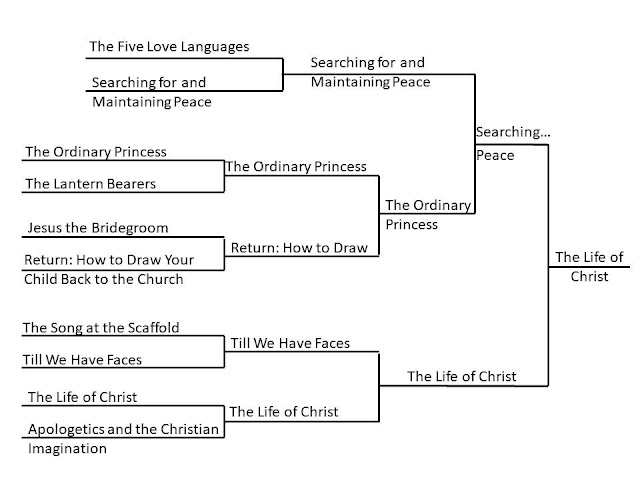
January: Searching for and Maintaining Peace
February: The Ordinary Princess (it was a tie in the month bracket and I gave the victory, months later, to the book I found more memorable and dear to my heart)
March: Till We Have Faces
April: The Song at the Scaffold
May: Return: How to Draw Your Child Back to the Church
June: Jesus the Bridegroom
July: Apologetics and the Christian Imagination
August/September: The Lantern Bearers
October/November: The Five Love Languages
December: The Life of Christ

There are 10 winners here because I had two brackets combining two months of light reading each. Four of the winning books were fiction; four were spiritual works; the last two were nonfiction.

2021 Winner Book Bracket

Alright, time for the 10 winners of each month to play for the championship title for the year!


The big winner of this year was "The Life of Christ", a new read, and not a reread like last year's "Story of a Soul". It was still a spiritual work, though. I loved Fulton's imagery and the lines that struck me to the heart. I loved it so much that I recorded lines that struck me into a little notebook so I could look back at them later, and I'm so glad I did. This is definitely a book I'd recommend to someone who wants to reflect on Jesus' life and takes their Catholic faith seriously. It's a big time investment because it's long, but it is so worth it. Thank you for joining me for end-of-year reflections on reading, and there will be more to come next month.

Monday, January 3, 2022

December Book Brackets

 December Books Brackets

I didn't want to catch COVID, but I did. At least I was able to get a little bit of reading in during all those days at home!


Parnassus on Wheels, by Christopher Morley*

Helen, tired of caring for her author brother and taking care of the farm when he goes rambling for materials, purchases a large van that is a traveling bookstore and has adventures in the New England countryside over the course of half a week.

Why I picked it up: I was at home during COVID and struggling; a fluff read was greatly desired, and I recalled at long last that a friend had recommended this book to me and it was waiting on my Kindle.

My impressions: Yes, this was a fluff read, but a quick and easy one. The story itself was not very ambitious and lacked a driving plot, but it was a fun little romp. Not a Chesterton-sized or -styled romp, but a modest little one that every now and then celebrated the joys of being a reader. It also wrapped up nicely at the end. The story had a negative perspective on "hobos", or homeless men, but it was very much a squeaky-clean sort of book. The small romance was predictable (the author gave it away in the introduction) and not terribly well developed, but it was sweet. This is a great pick for someone who wants a clean, very quick fluff-read. I'm curious about the sequel.

Life of Christ, by Fulton Sheen

The famous Archbishop Sheen dives into Scripture and explores the life of Christ.

Why I picked it up: This book (and probably most other works by Sheen) was on my to-read list and I felt like I hit the jackpot when I found a copy at the garage sale of one of my friend's mom.

Quote: There are too many, so I include several here.

"Knowing all, the Son of God made Peter, who knew sin, and no John, the Rock upon which He built His Church that sinners and the weak might never despair." -p. 339

"Sacrifice does not mean 'giving-up' something, as if there were a loss; rather, it is an exchange: an exchange of lower values for higher joys." -p. 167

On Jesus and the Good Thief: "A dying man asked a dying man for eternal life; a man without possessions asked a poor man for a Kingdom; a thief at the door of death asked to die like a thief and steal Paradise. One would have thought a saint would have been the first soul purchased over the counter of Calvary by the red coins of Redemption, but in the Divine plan it was a thief who was the escort of the King of kings into Paradise...It was the thief's last prayer, perhaps even his first. He knocked once, sought once, asked once, dared evertying, and found everything." -p. 374

My impressions: This is an amazing book. Incredible. Insightful. Thoughtful. I could tell Fulton did a lot of praying and thinking for this work. I loved reading it, bit by bit, in my morning meditation. I felt like the makers of "The Chosen" show would benefit from reading this work. It was so good. I recorded favorite quotes as I read; Fulton has an almost Chestertonian turn of phrase at times, sometimes making a point with a paradox, and other times, wowing the reader with a well-worded thought. I highly recommend this book to anyone to loves Jesus and can handle the reading level.

Searching for and Maintaining Peace, by Father Jacques Philippe

As described before, the book examines content indicated by the title: searching for and maintaining spiritual peace.

Why I picked it up: I was again anxious and worried about many things and decided it was a good time to reread it.

My impressions: This book didn't hit or help me as it has the last three times I've read it. I suppose that is to be expected when one reads a book: it doesn't always have the exact same effect. However, that doesn't keep it from being an excellent book. See previous posts for more details on my thoughts on this one.

The Haunted Bookshop, by Christopher Morley*

The couple from "Parnassus on Wheels" have settled into life in Brooklyn, New York, as second-hand booksellers, and they and two young people work through a mystery that comes to their shop.

Why I picked it up: Another fluff read was required.

My impressions: This was another solid fluff read with not much plot, but just enough - especially as the story goes on - to be a little mysterious. There was some anti-German sentiment sprinkled throughout the book, and some negative portrayals and/or discussions of Germans. I disliked the long tirades the bookshop owner Mifflin went on either in conversation or in his imagination - they were lecture-y and it sounded like he was spouting what I assume is the author's views on literature and various other subjects. Or maybe they are just the character's views. In any case, they were too-well-expounded. This book is a fun sequel to "Parnassus on Wheels", although it had some questionable anti-German sentiments.

The Thirty-Nine Steps, by John Buchan, read by Adrian Praetzellis**

This adventure tale follows a South African in England as he flees his enemies after being drawn into a spy's attempt to ward off a political assassination that could result in war.

Why I picked it up: I was going through a period when listening to my usual podcasts seemed to be exacerbating some concerns of mine, so someone recommended that I switch things up. I thought giving an audiobook a try might be nice, so I found this recording on LibriVox, which is a site/app that provides free audiobooks of works in the public domain. Volunteers help record these works, and I have marked the title with a ** to indicate it was not read from a regular book or from an ebook, but was an audiobook that I listened to.

My impressions: This was a pretty short book - only ten chapters - but filled with lots of excitement from the first few pages. Some of the escapades of this untrained and unsuspecting main character were unrealistic from someone who had never done any spy work before, but those unlikelihoods didn't detract from the story. The story was fast-paced and not bogged down by politics, which I found refreshing (some political intrigues take too much time, in my opinion - but not in this story). There was a scene in the first few chapters that described a murdered chap - not in gruesome detail, but it was enough detail that I might have skimmed if I were reading. The narrator had different voices and accents for some of the characters and did a great job overall. This audiobook is an exciting and quick work to listen to, especially quick if one listens to it at 2x speed like I did.

Letters From Father Christmas, by J. R. R. Tolkien

The famous author of The Lord of the Rings series wrote letters to his children for many years - he wrote them as if he were Father Christmas and responded to the letters they wrote to him. Characters such as a North Polar Bear, a secretarial elf named Ilbereth, and various others make debuts through the years and continue their appearances as Father Christmas prepares toys, fights goblins, and deals with the North Polar Bear's foibles from year to year.

Why I picked it up: Earlier this year, a cousin asked if I had read this book before, and I had not. Closer to Advent, I decided I wanted to read it, so I put it on hold through the library's FREE hold system.

My impressions: This is a very interesting work. I appreciate that it has some of the same story-telling qualities that Tolkien's other works showcase, but it has a different feel because the letters are so personal and written for his family. Illustrations were included in this work, and that was an absolute joy to look at - the experience just wouldn't have been the same if I couldn't see the pictures "Father Christmas" was referencing. It was obvious that Tolkien put a lot of time into these letters and pictures. Reading these letters was like looking through a little window into the lives of a family around Christmas time; yes, it's a limited view, but a very sweet and, in some ways, intimate experience. I think this book would be good to read around Christmas if one is a fan of Tolkien, or perhaps wants to share some Christmas joy with others. Maybe it would be a good family activity to read it together (not my idea, but it sounds like it could be a good one).

Praying the Rosary Like Never Before, by Edward Sri

Dr. Sri explains the reasons for praying the Rosary, its history and background, different methods for praying it in a meaningful way, and reflections on the twenty different mysteries.

Why I picked it up: I bought it as a three-book deal at the Midwest Catholic Family Conference this year and wanted to knock out another book from my never-shrinking "to-read" stack.

My impressions: There are other books that go more in-depth into the background of the Rosary, but I liked that Sri referenced an encyclical by Pope St. John Paul II throughout his book (I hadn't heard about the encyclical before). He also provided ten verses for every mystery for those who want to pray a Scriptural rosary (a Rosary where one recites one or more Bible verses per mystery to assist meditation on that mystery) and practical tips for praying the Rosary. I do hope to use the Scripture verses and reflections sometime in the future when I pray the Rosary by myself. Overall, I'd say the book was a mix of information I'd heard before and solid new insights and ideas for connecting better with this prayer. It would be a good introduction to the Rosary or a good book for someone who is familiar with the Rosary, but hasn't read much on it.

Bracket Play


In the opening round, I paired the weaker fiction works by Christopher Morley with stronger works of fiction (the exciting "Thirty-Nine Steps" and Tolkien's letters as Father Christmas). This may scandalize some who know me, but I decided I liked "The Thirty-Nine Steps" better than Tolkien's work. The letters are sweet, but I don't find them as memorable as the action-packed story by John Buchan. I can imagine myself rereading Buchan's work sooner than Tolkien's Father Christmas letters, but who knows if that will be the case in reality, or if I will have the chance to reread them? The play-in game was won easily by Sheen's "The Life of Christ," which is simply fantastic. That book won the bracket this week and definitely has a chance at winning the championship for the whole year.

Sunday, December 5, 2021

October-November Book Brackets


October and November

October is looking to be a pretty light month for reading again, so I'm again going with a combined bracket.


The Five Love Languages: The Secret to Love That Lasts, by Gary Chapman

Counselor Gary Chapman describes the five love languages, or the five main ways he's found that spouses feel and express love in their marriages; the five loves include words of affirmation, quality time, receiving gifts, acts of service, and physical touch.

Why I picked it up: I was talking to someone about the five love languages and they said they hadn't really read up on them, but they thought they might. I figured now was a good time to reread the book (I'd read it in college for my interpersonal communication class) before I offered to lend it to them.

My impressions: I believe this book (or one of its variations) is an important one for people to read. This is a reread for me and I remembered much of what was in it, but it was good to refresh. I like that the author brings years of counseling experience and real-life stories to bear on his school of thought. His writing is simple and straightforward, so it is easy for readers to understand and quick to go through (200 pages, finished in a day or two). This book focuses on couples who have been married for a while and may desire to rekindle the emotional spark of their relationship, but it nevertheless has great insights even for the single person, as I recalled from my first read. I would highly recommend this book to married couples, and one of its variations to single people (haven't read any, but I'm sure they'd be great). It has immediate applications and can help increase self-knowledge. This is basically the kind of book I think any adult would benefit from reading.

The Awakening of Miss Prim, by Natalia Sanmartin Fenollera

This novel follows the tightly-laced, modernist, skeptical Miss Prim as a she takes a job as librarian for an intelligent and hard-to-pin-down Man in the Wing Chair in a village that seems caught in a former time.

Why I picked it up: The book I had been reading previously wasn't doing much for me at that time and I wanted a story. This book had been on my reread list for a while.

My impressions: I enjoyed the book the first time I read it, but I had only half understood what was going on. Now, I maybe two-thirds understand what is going on. I found myself caught up in the book and just wanting to sit for hours to read it, which is not something I expected from a book I'd read sometime in the last seven years. It pays homage to the perceived "simpler times" of the past, with descriptions of comfortable gathering spaces for community and delicious-sounding food. I appreciate the timeless aspect of it - excepting a mention of computers near the beginning, this story feels like it could have taken place any time within the last century. I found it interesting that the author left out some of the more typical descriptive details; in fact, there are very few (we know the main character has an upturned nose and honey tones in her hair), and the build of a few characters is suggested, but at most, we hear that individuals are "attractive", etc. It is the personality and character that matters in this book. Many of the conversations, if I'm honest, are not that believable, but they are still charming. There is romance, yes, but it's not cloying. The wider search of the heart for what it truly desires took at least equal importance to the romantic storyline. The book is well written and clearly an homage to Great Books programs, with a mention of Kansas at the beginning, an allusion, I'm sure, to KU's renowned Great Books program and the community around Clear Creek Abbey that seems to have ties to the program. This is a great book for those who have at least a rudimentary understanding of Great Books programs or classical education. The book would still likely be enjoyable to those unfamiliar with such educational perspectives, but it probably wouldn't make as much sense.

The Catholic All Year Compendium: Liturgical Living for Real Life, by Kendra Tierney

Catholic mom Tierney explains the liturgical year and breaks it down by seasons and major feast days/solemnities/holy days of obligation, gives background, and shares ideas about how to celebrate these key moments of the Catholic year in one's home.

Why I picked up the book: I heard about this book from a good friend and obtained it for Christmas one year. However, it sat on my "to read" pile of the shelf for a while and I was long overdue to actually pick it up and read it.

My impressions: This is a great resource for those who want (and have energy) to celebrate the liturgical year in ways outside of the liturgy. Tierney's work comes across as extremely orthodox, well-researched, and creative. I learned about saints I was not familiar with before, deepened my knowledge of various feasts and saints I already knew, and garnered some ideas for the not-near future when I might try to put more of these activities into practice. This book is definitely geared towards those with children living at home. I think many of the activities could be done by a single person or a couple, but the effort might outweigh the benefits; it sounds like some of these activities are work-intensive, but can be used as opportunities for teaching young ones about the faith. I would recommend this book to any Catholic who wants to get some ideas about "liturgical living." The only thing that would round out this book would be a cookbook with all the recipe ideas, a how-to guide for all other activities and crafts, and the now-published "The Catholic All Year Prayer Companion", which contains, I presume, prayers to accompany the book.

The Lost Baron, by Allen French

This historical fiction tale about Medieval times follows the page Martin as he advances according to his state in the castle of a baron who mysteriously disappeared.

Why I picked up the book: I had read and enjoyed two other books by the same author and purchased it at a discount at a local Bookaholics store. I was in need of a quasi-fluff read and decided some children's literature, historical fiction genre, was called for.

My impressions: This book is a fine adventure tale, even though it did not have the strongest plot. There was more an overhanging mystery throughout the tale than a forward-moving storyline, but there was plot enough to keep me engaged. I found the tale believable, as well as the character development. There were a few descriptions that tired me, but there was one chapter that I found particularly interesting - it included switching between the perspectives of multiple characters observing or participating in a single event. My one or two words to parents is that all these Medieval characters put a lot of stock in "luck", with a "lucky" penny being a major part of the story; parents might wish to discuss the Catholic viewpoint on luck, etc. before a child reads this book. Also, there are some instances injustice and violence. Otherwise, this book is appropriate for readers of chapter books - probably older elementary and on, especially those who like a good adventure.

Dear Enemy, by Jean Webster

This sequel to "Daddy Long Legs" follows Sallie McBride, a college-educated and somewhat air-headed woman who takes on the task of running and improving the orphanage her friend was raised at. It also follows the development of her friendships/relationships with different characters, all explored in an epistolary format.

Why I picked up the book: I needed a fluff read and this was on my kindle; I'd read "Daddy Long Legs" within the last few years.

My impressions: Definitely a fluff read, it's the sort of story a light romantic comedy could be made out of. It was a pretty quick read and easy on the brain, being very predictable. However, I definitely took issue with and skipped some sections that seemed to promote a eugenics mindset - the descriptions of some orphans and their parents (with problematic histories) announced a perspective that sees some lives as more worthy and deserving and valuable than others, which I did not appreciate. Marriage is also not necessarily viewed as indissoluble, at least in the case of one character. Although a sequel to another book, this tale stands pretty well on its own - all someone would need to know would be that two of the people Sallie writes to are her college friend (main character of "Daddy Long Legs") and that woman's husband. I don't know if I'd necessarily recommend this book to read, but if one doesn't mind reading the sections I disliked, or is ready to skip them, and is desirous of a fluff read, this could be a possible candidate. Definitely not the sort of book I'd anticipate a guy appreciating.

Bracket Play


This is another bracket that has an odd number, so it was decided that Gary Chapman's "The Five Love Languages" would have a buy the first round. The two romantic reads, "The Awakening of Miss Prim" and "Dear Enemy" were pitted against each other. "Miss Prim" won handily due to its substance and creativity over the eugenics-laced epistolary novel. A mismatch happened with the other first-round game, with one book being a children's historical fiction work and the other a niche area of Catholic content. It could have gone either way, but the victory went to the book I am more likely to reference and apply to my daily life, "The Catholic All Year Compendium". This book lost quickly against the favored "Five Love Languages," the book that went on to win the overall competition against another reread. Chapman's book is applicable to everyone in some way, even if they are not married. "Miss Prim", though excellent in certain ways, is not a book that I agree with 100%. It provides food for discussion, but does not have the universal appeal of Chapman's book.